PSLE Science Water Cycle Keywords for OEQ
Part 2 of 3 of the PSLE Science OEQ Guide: saying the science accurately, topic by topic, and why the everyday phrase gets it wrong.
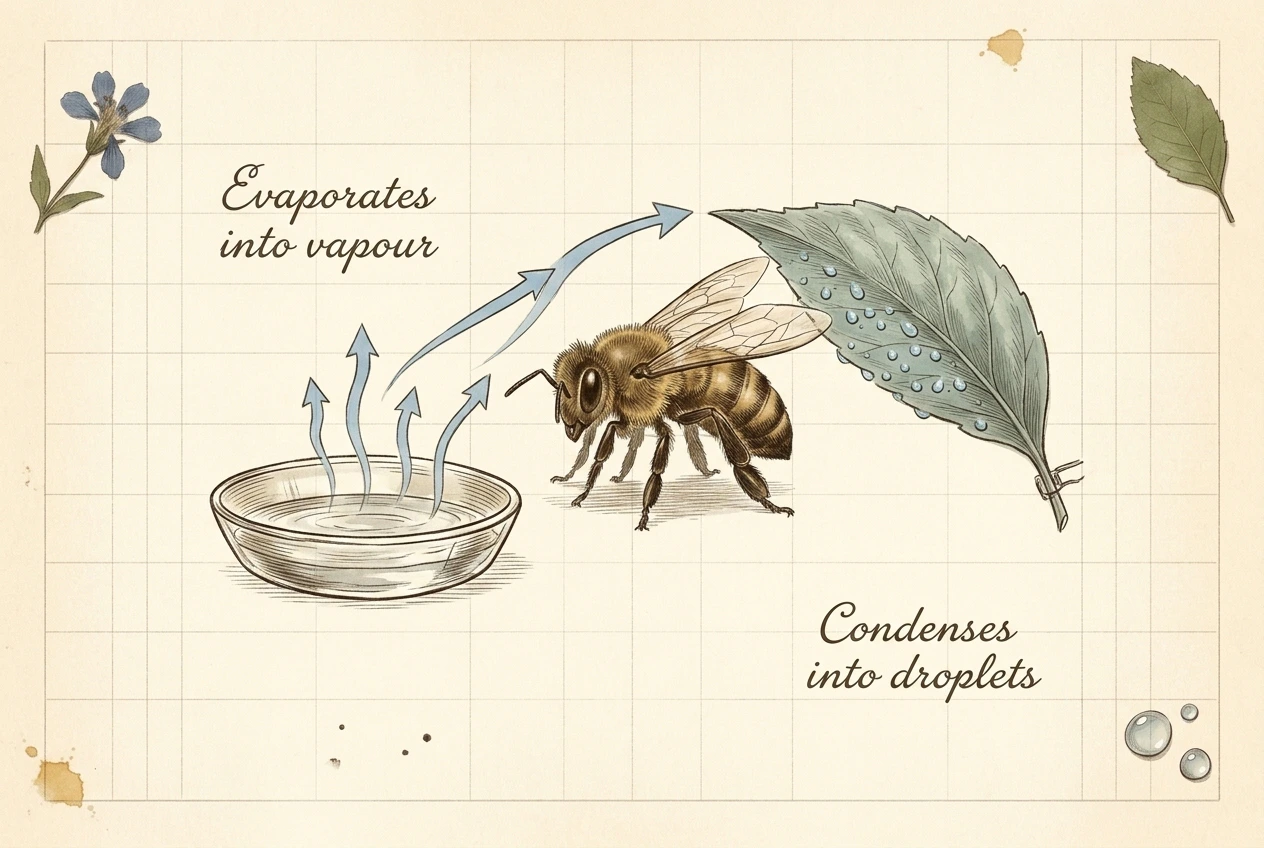
The water cycle rests on one idea. Matter does not vanish. It changes form. At home, a puddle "disappears" and sugar "melts" in tea. Those are the words that come to mind first. Both of them suggest the matter was destroyed. None of it was. Let's keep the water in view the whole way. Liquid water, then water vapour, then droplets. It is the same water each time.
The fix isn't a longer answer. It's a word that says what happened to the matter.
1. "disappeared" → "evaporated"
The puddle on the road evaporated by the afternoon.
"Disappeared" sounds like the water is gone for good. It is not. The puddle took in heat from the sun. The liquid water changed into water vapour. That's a gas. It's still in the air, just too spread out to see. That change is called evaporation. It can happen at any temperature. It happens only at the surface of the liquid. That's why it's slow.
2. "melted" / "disappeared completely" → "dissolved, and is still there"
The sugar dissolved in my hot tea. After stirring it is still there, just too small to see.
Two everyday words, and the same mistake behind both. Nothing was destroyed.
Melting is when a solid turns into a liquid of the same substance. Ice into water is melting. It needs heat.
Dissolving is different. The sugar breaks up into bits far too small to see. Those bits spread out evenly through the hot water. The sugar is mixed all through it now.
The sugar is still sugar. It never became liquid sugar. You can prove it. Taste the tea. Or let the water evaporate, and the sugar is back. For the full difference, see melting vs dissolving.
3. "you can see the steam" → "the white mist is condensed water droplets, not steam"
The white mist rising from the boiling pot is made of tiny condensed water droplets, not steam.
Real steam is the water vapour straight off boiling water. It is a gas at 100°C. Gases are invisible, so you can't see real steam. The white mist is something else. That vapour has lost heat to the cooler air. It has condensed back into tiny drops of liquid. So the mist is a liquid again, not a gas.
4. "water appeared on the cold can" → "water vapour condensed on the cold can"
Water vapour from the air condensed on the outside of the cold can.
The air around us always holds water vapour. You just can't see it. When that vapour touches the cold can, it loses heat and condenses into tiny liquid droplets. Those droplets are the water you see on the outside.
"Water appeared" leaves out both of those steps. It doesn't say where the water came from, and it doesn't say how it got there. So name the source, which is water vapour in the air. Then name the process, which is condensation.
5. "turns into gas" → "evaporates into water vapour"
The puddle evaporates into water vapour and goes into the air.
"Turns into gas" is not wrong, but it leaves out two useful Science terms. The process is evaporation, and the gas formed is water vapour.
The swaps
| # | Say this | Why it earns the mark |
|---|---|---|
| 1 | Evaporated | Names the change into water vapour |
| 2 | Dissolved, still there | Says the sugar is still there, in the water |
| 3 | Condensed water droplets | Names the white mist as tiny liquid droplets |
| 4 | Water vapour condensed | Says where the water came from |
| 5 | Evaporates into water vapour | Names the gas the water becomes |
You're not learning a set phrase here. Follow the water from one state to the next. Say that in your own words, and the answer still works.
If you want to try this on real questions, MCQ.SG marks open-ended questions point by point and gives feedback on every answer.
For more tips on improving your answers—from avoiding common mistakes to using precise science language—explore the complete PSLE Science OEQ Guide.