PSLE Science Light Keywords for OEQ Answers
Part 2 of 3 of the PSLE Science OEQ Guide: saying the science accurately, topic by topic, and why the everyday phrase gets it wrong.
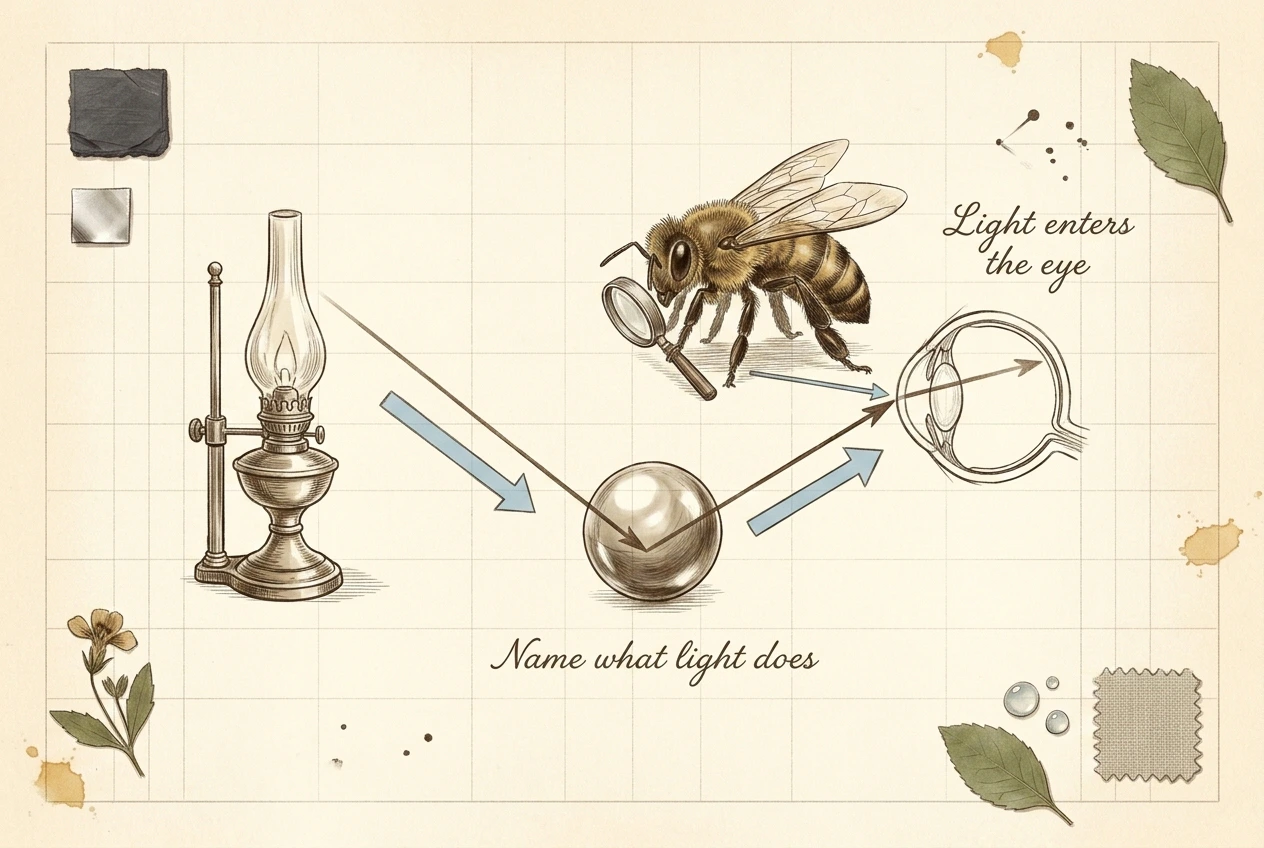
Light asks you to explain something that seems too obvious to need explaining. Why can you see things at all? The whole topic runs on one path. Light leaves a source. It reflects off an object. Then it enters your eye, which is what lets you see the object.
The other half of the topic is about materials. Some materials let nearly all the light through. Some let only a little through. Some let none through at all. What an answer needs is which of those three it is.
1. "because the light is on" → "because light reflects off it into my eyes"
I can see the ball because light from the lamp reflects off the ball and enters my eyes.
Turning a light on doesn't explain how seeing works. Most objects don't make their own light. Light from a source must hit the object first. It then reflects off the object and enters your eyes. "The light is on" leaves out that second part.
2. "bounces off" → "reflects off"
Light reflects off the mirror and hits the wall.
"Bounces off" only gives a rough picture of what happened. In Science, we say that light reflects when it hits a surface and changes direction. A smooth mirror reflects light evenly. That is why it forms a clear image.
3. "you can see through it" → "it is transparent"
The window is transparent, so you can see through it clearly.
"See through it" reports what you saw. What the answer needs is how much light gets through. A transparent material lets nearly all the light pass straight through. "Transparent" is a one-word way to say that.
4. "blocks the light" → "is opaque"
The curtain is opaque, so it blocks all the light from outside.
"Blocks the light" is correct, and it is close. Say how much light gets through, and it's complete. An opaque material lets no light through at all. "Opaque" says the same thing in one word.
5. "lets a bit of light through, but blurry" → "is translucent"
The frosted glass is translucent, so everything behind it looks blurry.
"Looks blurry" reports what you saw. A translucent material lets only some of the light through. That's why you can't see clearly through it. "Translucent" is the one-word version.
6. "casts a shadow" → "is opaque, and blocks light to form a shadow"
The wall is opaque. It blocks light, so a shadow forms on the ground where the light cannot reach.
"Casts a shadow" is the everyday way of putting it. It doesn't say how the shadow forms. A shadow is the place where light did not reach. The opaque wall blocked it. Light travels in straight lines, so it cannot bend around the wall to fill that space.
The swaps
| # | Say this | Why it earns the mark |
|---|---|---|
| 1 | Because light reflects into my eyes | Traces the light all the way to the eye |
| 2 | Reflects off | The Science word for light changing direction at a surface |
| 3 | Transparent | Says nearly all the light passes through |
| 4 | Opaque | Says no light passes through |
| 5 | Translucent | Says only some of the light passes through |
| 6 | Blocks light, forming a shadow | Says a shadow is where light is blocked |
Nothing here is a phrase to memorise. The three naming words are handy: for example, "lets no light through" explains what "opaque" means. Follow the question if it asks you to name a property. When explaining, make the relevant light path clear; different wording can express the same science.
If you want to try this on real questions, MCQ.SG marks open-ended questions point by point and gives feedback on every answer.
For more tips on improving your answers—from avoiding common mistakes to using precise science language—explore the complete PSLE Science OEQ Guide.