PSLE Science Heat Keywords for OEQ Answers
Part 2 of 3 of the PSLE Science OEQ Guide: saying the science accurately, topic by topic, and why the everyday phrase gets it wrong.
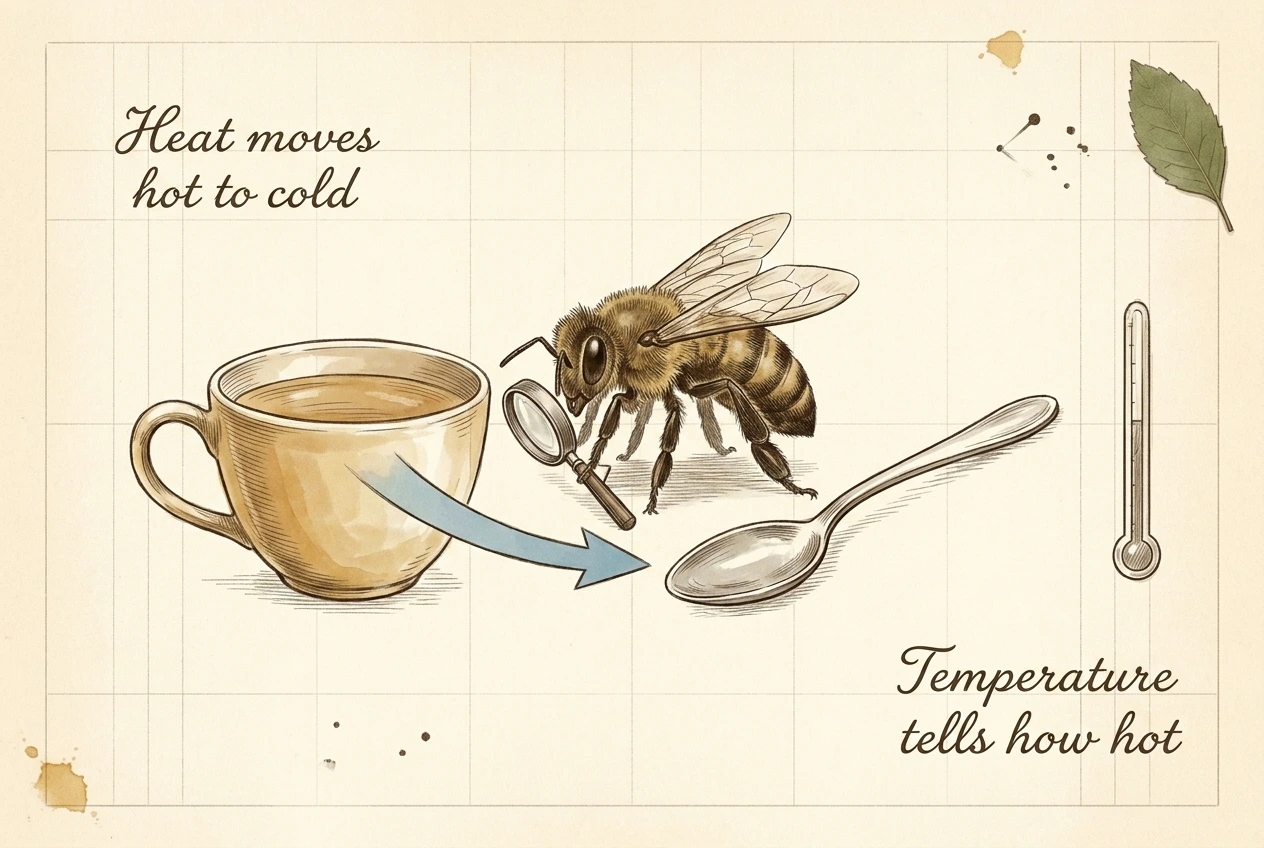
Heat is the first topic where the words we use at home stop being exact enough. "Hot," "cold," "bigger" and "smaller" are the words that come to mind first. They're fine for everyday use. In a Science answer they say something slightly different from what you mean.
Heat and temperature are two different things. Heat is energy. It moves from a hotter place to a colder place. Temperature is a measure of how hot a thing is right now.
1. "got smaller" → "melted"
The ice cube melted in the cup of warm water.
"Got smaller" is what a drying puddle does. So it sounds like matter was lost. The ice lost none of it. It took in heat from the warm water. It changed from a solid to a liquid. All the water is still there. It is just in a different state.
2. "gets hot" → "gains heat"
The metal spoon gains heat when you leave it in the soup.
"Gets hot" gives you the end of the story only: the temperature went up. It doesn't say why. The spoon gets hot because it gains heat from the hotter soup. That's the step "gets hot" skips.
3. "cools down" → "loses heat to the surroundings"
The hot soup loses heat to the surroundings after a while.
"Cools down" tells us what happened, but not why, and not where the heat went. Heat moves from the hotter soup to the cooler air around it. If the question asks for an explanation, say that the soup loses heat to the surroundings because they are cooler than the soup.
4. "gets bigger" / "shrinks" → "expands" / "contracts"
The metal bar expands when it gains heat. It contracts when it cools.
"Gets bigger" and "shrinks" describe what we can see. They can also mean other things — more of something, or something wearing away. "Expands" and "contracts" can only mean one thing. The metal takes up more space when it gains heat, and less space when it loses heat. No metal is added or lost either way.
5. "feels cold" → "conducts heat away from your hand"
The metal railing conducts heat away from your hand faster than the wooden bench does.
This comparison turns up often in PSLE questions. The railing and the bench are at the same room temperature. Metal is a good conductor of heat. Wood is a poor one. So heat moves out of your hand into the railing much faster than into the bench. That is what makes the railing feel colder, even though it isn't.
6. "gets hotter and hotter until it disappears" → "stays at the same temperature while it boils away"
The water in the pot stays at 100°C while it boils away as water vapour.
Water heats up until it reaches its boiling point. Then it stops getting hotter. It still takes in heat, though. Instead of raising the temperature, that heat turns the liquid water into water vapour. That's why a graph of temperature over time goes flat while something boils or melts.
The swaps
| # | Say this | Why it earns the mark |
|---|---|---|
| 1 | Melted | Names the change of state |
| 2 | Gains heat | Says heat moved in, not just that it ended up hot |
| 3 | Loses heat to the surroundings | Says where the heat went |
| 4 | Expands / contracts | Says the metal takes up more or less space |
| 5 | Conducts heat away from your hand | Same temperature — metal is the good conductor |
| 6 | Stays at the same temperature while it boils | Says the heat changes the state, not the temperature |
None of the phrases here are wording you have to copy. If your sentence says what the heat did and where it went, it can earn the mark. Any words that do that will work. This is about getting the science concepts right, not about guessing a phrase.
If you want to try this on real questions, MCQ.SG marks open-ended questions point by point and gives feedback on every answer.
For more tips on improving your answers—from avoiding common mistakes to using precise science language—explore the complete PSLE Science OEQ Guide.