Melting vs Dissolving in PSLE Science
Six PSLE Science pairs that sound alike but test completely differently, and the one experiment that tells each pair apart.
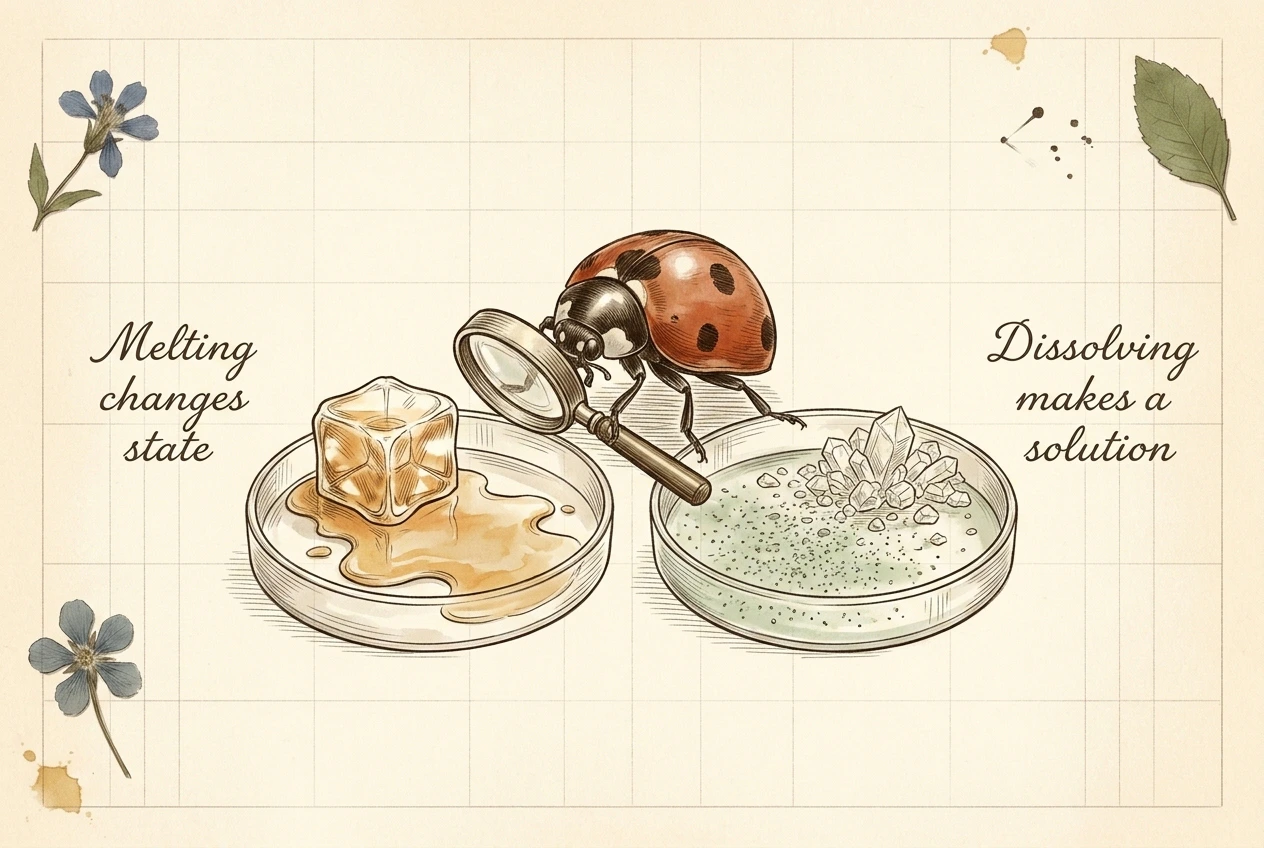
Leave an ice cube on the table. It "vanishes" into a puddle. Stir sugar into water and it "vanishes" too. The glass turns clear. Both look like the same trick. A solid goes in, the solid is gone, and only liquid is left. That's why people say "the sugar melted in my tea." Melting and dissolving are two different things, and exam questions will ask you which one is happening.
You have likely watched an ice cube melt on a saucer. It takes in heat from the room. What is left is water — the same stuff, now a liquid. You have also stirred sugar into water, then tasted it. The sweet taste proves the sugar is still there. It's just spread out too thinly to see. The two lessons come weeks apart. That's why they blur into one idea: "solid goes invisible in liquid."
| Melting | Dissolving | |
|---|---|---|
| How many substances | One (ice → water) | Two (a solid mixed into a liquid) |
| Needs heat? | Yes — heat is needed to change state | Not always — sugar dissolves in cold water too, just more slowly |
| What you end up with | A liquid of the very same stuff | A mix of two things — the solid spread through the liquid |
| Is the first substance still there? | Yes, now as a liquid | Yes, spread out as bits too small to see |
Melting turns one substance from a solid into a liquid. Dissolving mixes a solid into a liquid. Nothing melts when sugar goes into a drink.
The best test is to try to undo each one. Take the water from a melted ice cube. Put it in the freezer. Hours later you have ice again. So cooling undoes melting.
Now try the same on sugar water. You get sugary ice. The sugar is still mixed in. Cooling didn't bring it back. To get the sugar back, take the water away instead. Pour the sugar water into a flat dish. Leave it in a warm spot. The water evaporates. The sugar crystals appear again. So cooling undoes melting. Evaporating undoes dissolving.
Two questions sort out almost any case you meet. Did it need heat, or did it need a liquid to mix into? And is what is left one substance, or a mix of two?
(For the word swap behind the same confusion, see Matter & the Water Cycle: Say This, Not That.)
If you want to try this on real questions, MCQ.SG marks open-ended questions point by point and gives feedback on every answer.
For more tips on improving your answers—from avoiding common mistakes to using precise science language—explore the complete PSLE Science OEQ Guide.