Heat vs Temperature in PSLE Science
Six PSLE Science pairs that sound alike but test completely differently, and the one experiment that tells each pair apart.
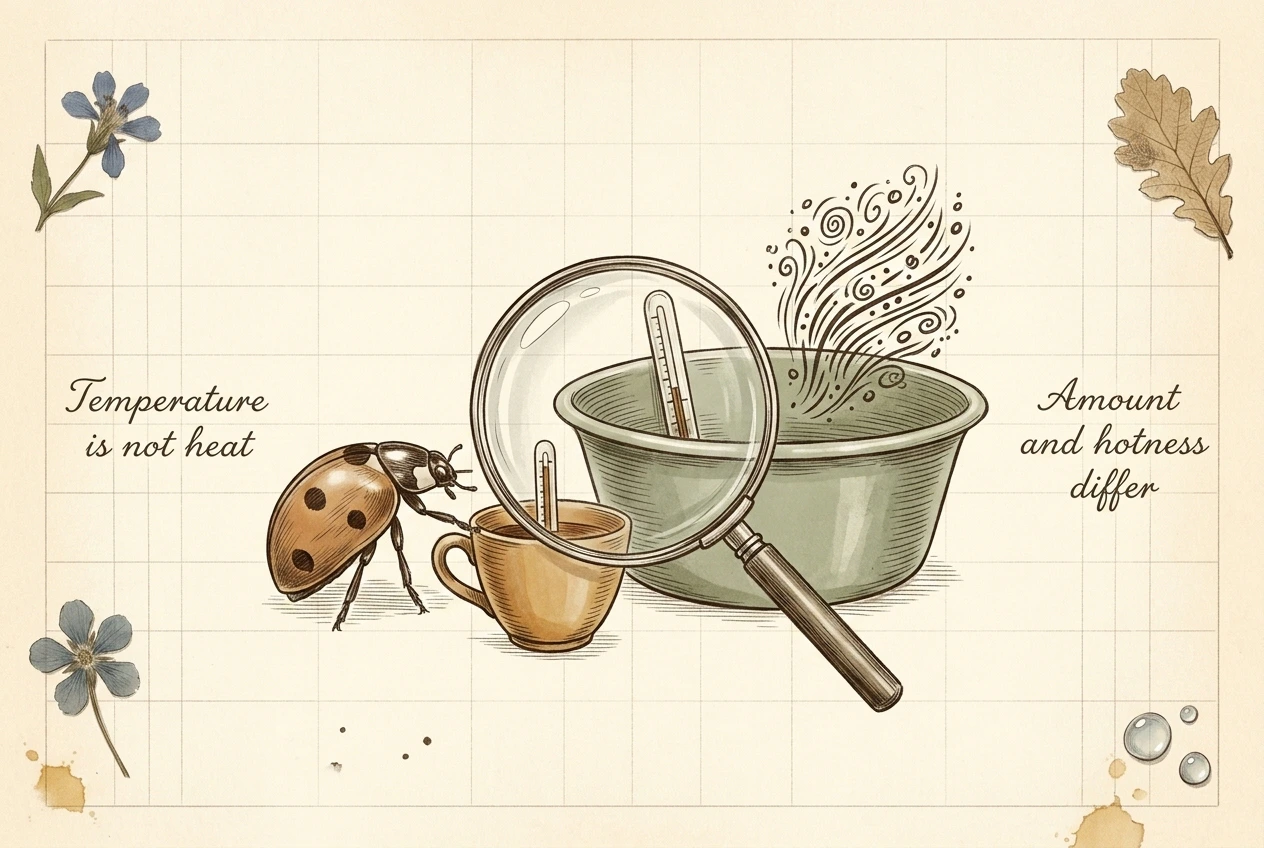
Which holds more heat: a cup of tea at 90°C, or a pool at 28°C? Most people pick the tea. The pool wins. Every bit of it is cooler than the tea. But there's so much more water in it. In daily life, heat and temperature go up together. So it's easy to miss that they are two things.
Six pairs in this series sound alike but are tested in very different ways. This is the first. You can also read about the seven answering mistakes that cost the most marks in open-ended questions.
You have likely done this one in class. Put crushed ice in a beaker. Heat it slowly. Take the temperature every minute, and plot it against time. That graph is the heating curve.
Let's see what its shape does. It goes up while the ice warms. Then it goes flat while the ice melts. Then it goes up again while the water warms. Then it goes flat once more at 100°C, while the water boils away.
Now the key part. The flame never stops. Heat goes in the whole time. Yet the line stops rising twice. If heat and temperature were one thing, the graph would be a single climb up. It is not. In each flat part, the heat is doing another job. It's changing the state of the water — ice into water, then water into vapour. It's not making the water hotter. The heat is still going in. The thermometer just can't show it.
| Heat | Temperature | |
|---|---|---|
| What it is | A form of energy | A measure of how hot or cold something is |
| Unit | Joules (energy) | Degrees Celsius (°C) |
| While melting or boiling | Keeps flowing in | Stays the same — a flat line on the graph |
| Depends on | How much there is AND how hot it is | Only how hot it is, not how much there is |
Temperature tells you how hot a thing is. Heat tells you how much energy went in to get it there. And you can pour heat in while the temperature does not move at all.
So what does a thermometer miss? It tells you how hot the water is right now. It can't tell you how much heat went in. It also has no idea how much water is in the beaker. Two beakers can both read 100°C. If one holds ten times more water, it holds ten times more heat.
If you want to try this on real questions, MCQ.SG marks open-ended questions point by point and gives feedback on every answer.
For more tips on improving your answers—from avoiding common mistakes to using precise science language—explore the complete PSLE Science OEQ Guide.