Evaporation vs Boiling in PSLE Science
Six PSLE Science pairs that sound alike but test completely differently, and the one experiment that tells each pair apart.
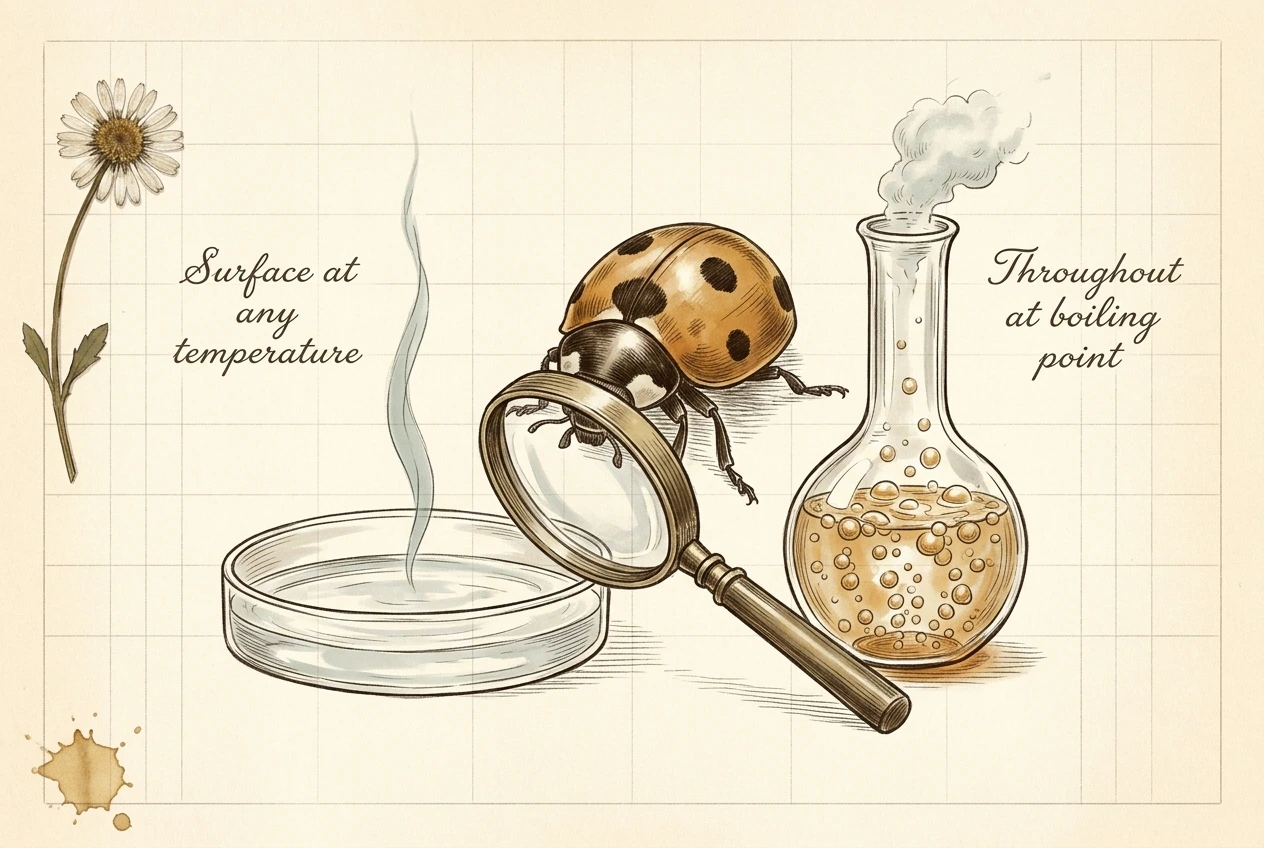
Wet clothes dry on the line with no flame near them. A pot left boiling on the stove ends up empty too. Both end the same way. The water has gone into the air as vapour. So "the water went away" gets read as one event. It gets named boiling or evaporating, based on which word comes to mind first. They are two things, not one. And saying that evaporation only happens when a thing is hot is a common way to lose marks in the Matter topic.
You have likely raced two wet cloths. One goes in a breezy or sunny spot. One goes in a still, shady corner. Then you check which dries first. No flame is used. That is evaporation. It happens at room temperature, and the water turns to vapour at the surface of each cloth.
You have also heated a beaker over a burner until it bubbles at 100°C. That is boiling. Let's see where the bubbles start. They rise from the whole beaker, not just the top.
| Evaporation | Boiling | |
|---|---|---|
| How hot | At any temperature | At one set temperature (100°C for water) |
| Where it happens | Only at the surface of the liquid | All through the liquid |
| Speed | Slow and quiet | Fast, with bubbles you can see |
| Needs heating? | No — it happens on its own at room temperature | Yes — heat must keep coming in, to reach and hold the boiling point |
Evaporation is water turning to vapour at the surface, at any temperature. Boiling is the whole body of water turning to vapour fast, with bubbles, at one set temperature.
Two short words tell the pair apart. Where and when. Evaporation is at the surface, at any time. Boiling is all through, and only at 100°C.
One tricky point fools nearly everyone. That white cloud above a boiling beaker is not steam. Real steam is water vapour. It's a gas, and you can't see it. The cloud is vapour that has cooled in the air. It's turned back into tiny drops of liquid water. So where's the steam? It's in the clear gap just above the water, below where the mist starts.
If you want to try this on real questions, MCQ.SG marks open-ended questions point by point and gives feedback on every answer.
For more tips on improving your answers—from avoiding common mistakes to using precise science language—explore the complete PSLE Science OEQ Guide.