Mass vs Weight in PSLE Science
Six PSLE Science pairs that sound alike but test completely differently, and the one experiment that tells each pair apart.
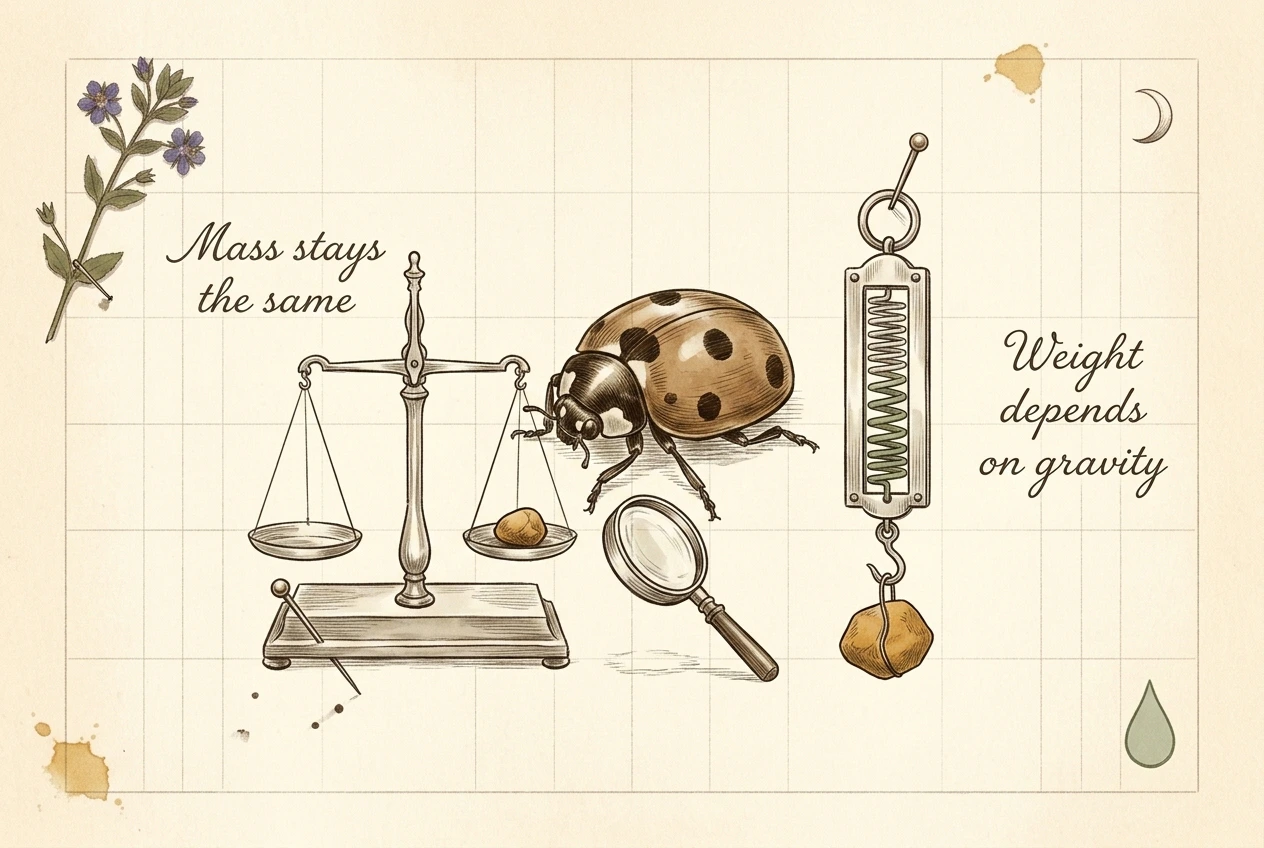
"How much do you weigh?" People answer that in kilograms every day. So by the time mass and weight turn up as two things to be tested, years of habit say they are one thing. They are also taught nearly two years apart. Mass usually comes in P4, under Matter. Weight usually comes in P6, under Force. They rarely sit side by side long enough for you to tell them apart. Two costly slips follow. One is giving weight in kilograms. The other is thinking an astronaut on the Moon has less mass, just because they float.
In P4 you put an object on a balance and read grams or kilograms. That is its mass: how much matter is packed inside it. In P6 you meet a spring balance. You hang the object on the hook and read newtons (N). That is its weight: the pull of gravity on the object. Same object. Two tools, two units, two years apart.
| Mass | Weight | |
|---|---|---|
| What it measures | How much matter is in an object | The pull of gravity on that object (a force) |
| Unit | Kilograms (kg) or grams (g) | Newtons (N) |
| Changes with place? | No — it stays the same everywhere | Yes — it depends on how strong gravity is where you are |
| Tool used | Balance (beam balance, electronic scale) | Spring balance / newton meter |
Mass is how much matter a thing is made of, and it never changes. Weight is how hard gravity pulls on that matter, and it changes with where you are.
The unit tells you which one an answer means. Grams and kilograms mean mass, read off a balance. Newtons mean weight, read off a spring balance. If an answer says "weight" and then gives kilograms, one of those two words is wrong.
Let's take both tools and the same object to the Moon. The balance still reads exactly what it read on Earth. The object is made of just as much matter as before. But the spring balance now reads about one sixth of its Earth reading. The Moon's gravity is much weaker, so it pulls less hard. That's why astronauts move in long, slow leaps. Not one gram of mass has gone. The force pulling them down has.
(For the everyday-word swap behind this same confusion — "heavier" vs "has greater mass" — see Forces & Magnets: Say This, Not That.)
If you want to try this on real questions, MCQ.SG marks open-ended questions point by point and gives feedback on every answer.
For more tips on improving your answers—from avoiding common mistakes to using precise science language—explore the complete PSLE Science OEQ Guide.