Germination vs Photosynthesis in PSLE Science
Six PSLE Science pairs that sound alike but test completely differently, and the one experiment that tells each pair apart.
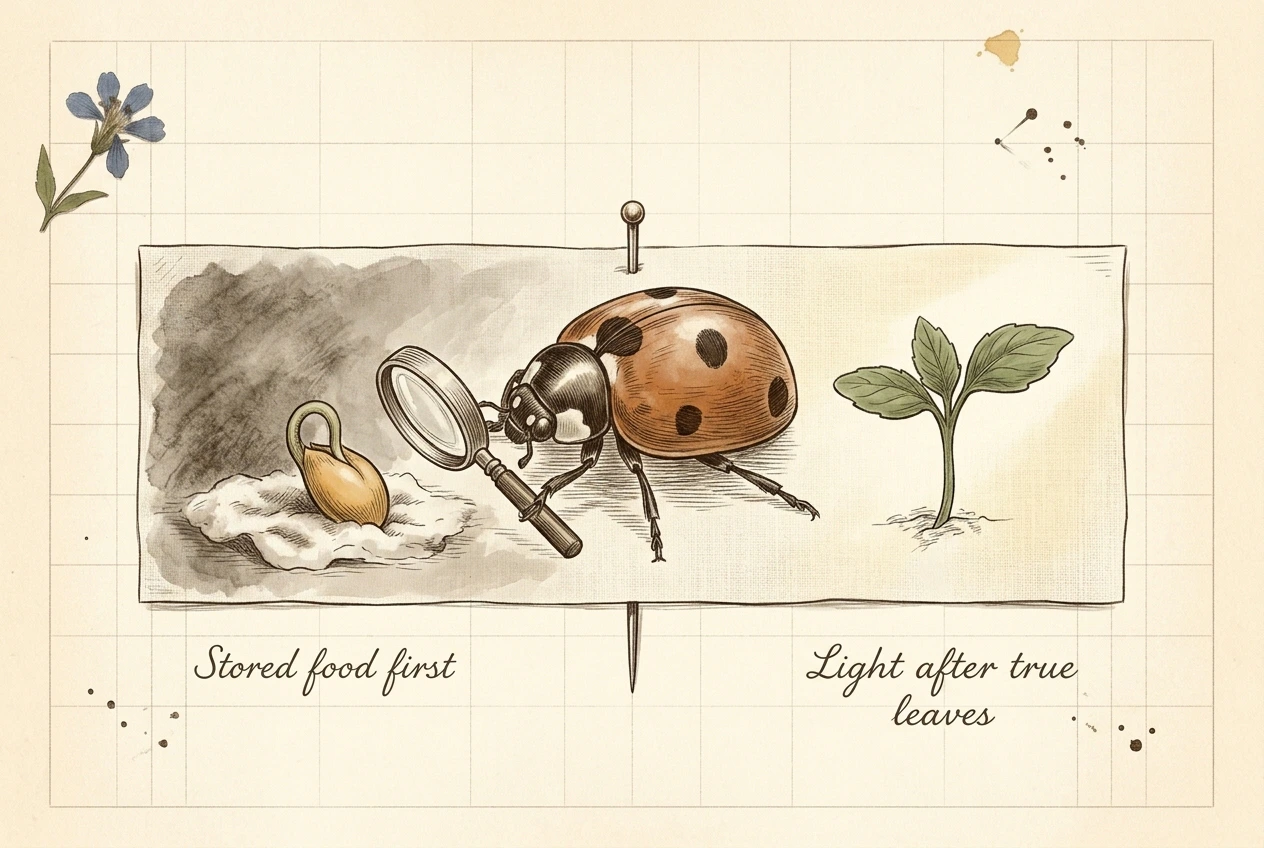
Ask what a plant needs to grow, and the first word out is nearly always sunlight. That's right, once the plant has leaves. The slip is using that answer one stage too early, and saying a seed needs sunlight to germinate. Germination means a seed sprouting. Growth by photosynthesis means a plant making its own food using light. They are two stages, with two different lists of needs, and the line between them falls at one exact moment: when the first true leaves open.
The whole topic fits on one strip: seed → first leaves → grown plant. Only the first step runs with no light.
You have likely grown a green bean seed in damp cotton wool in a clear cup. There's no soil, so you can watch the root (radicle) and shoot (plumule) push out. For what a seed needs, your teacher may have taught W.O.W.: Water, Oxygen, Warmth. Let's see what is not on that list. A seed needs no light and no soil to sprout.
| Germination | Growth (Photosynthesis) | |
|---|---|---|
| What is needed | Water, Oxygen, Warmth (W.O.W.) | Light, water, carbon dioxide |
| Where food comes from | Food stored in the seed leaf (cotyledon) | Made by the plant itself, using light energy |
| Needs light? | No | Yes — a must, once true leaves appear |
| Needs soil? | No — water, air and warmth are enough | Usually yes, for water and nutrients (but not for light) |
Germination needs only water, oxygen and warmth, and it runs on food already stored in the seed leaf. Growth by photosynthesis starts only once true leaves appear, and it needs light so the plant can make its own food.
Keep that bean cup going past sprouting and you can watch the change happen. While the seed sprouts, it makes no food at all. It lives off the food packed inside its seed leaf, the cotyledon. That's why a seed sprouts just fine in a dark cupboard.
Then the true leaves open. Now split the seedlings. Put one cup by a sunny window and one in the dark cupboard. Water both the same. In a few days the sunlit one is still green and still growing. The dark one turns pale yellow, stops, and dies back. That's the moment photosynthesis becomes a must. The stored food has run low, and only light lets the plant make more.
If you want to try this on real questions, MCQ.SG marks open-ended questions point by point and gives feedback on every answer.
For more tips on improving your answers—from avoiding common mistakes to using precise science language—explore the complete PSLE Science OEQ Guide.