Heat vs Electrical Conductors in PSLE Science
Six PSLE Science pairs that sound alike but test completely differently, and the one experiment that tells each pair apart.
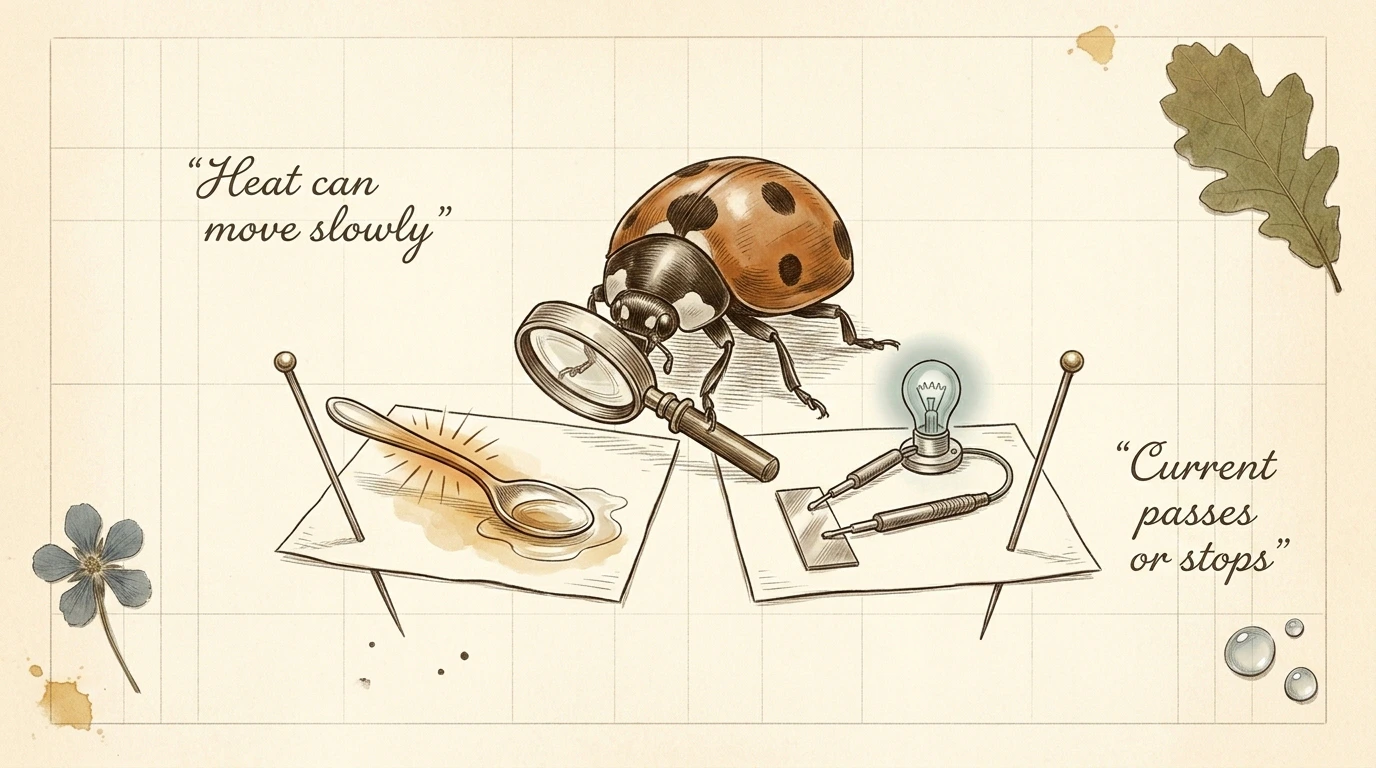
"Metal is a conductor" is said so often that the word starts to feel like one label. A thing either has it or it doesn't. But there are really two jobs here, and they happen to meet in metals. The costly slip is this: thinking a poor conductor of heat blocks heat, the way the plastic on a wire blocks electricity. It does not. These are two tests, and each has its own rule.
So ask two things, not one. Does heat pass through it, and how fast? And does current pass through it at all? The first has a speed for its answer. The second is a yes or a no.
You have likely done the butter test. Dab butter near the top of a metal spoon, a plastic spoon and a wooden spoon. Stand all three in hot water. Then let's see whose butter slides off first. Metal wins with ease. You have also used a circuit tester with a bulb and a battery. You touch a thing across a gap in the wire. The bulb lights up for metals. It stays dark for plastic, rubber and wood.
| Conductor of Heat | Conductor of Electricity | |
|---|---|---|
| What flows through it | Heat energy | Electric current |
| Good conductors | Metals (copper, aluminium, iron) | Metals (copper, aluminium, iron) |
| Are there true insulators? | No — all materials let heat through, but some are very slow (poor conductors) | Yes — some materials, such as plastic, rubber, wood and air, do block current |
| How you test it | Butter on a spoon, to see how fast heat moves | A bulb and battery circuit tester |
All materials let heat through, though some are far slower than others. Electricity is not like that. It has real insulators that stop current completely. So "poor conductor" and "insulator" mean two things, and which one you get depends on which flow you mean.
Here's a test you can run. Wrap one ice cube in a poor conductor, such as thick cloth or foam. Put a bare ice cube next to it. Let's think what should happen. Say a poor conductor did block heat, the way an insulator blocks current. Then the wrapped cube would never melt at all.
It melts every time. It just takes longer. The cloth slows down how fast heat reaches the ice. It can't stop heat from getting there in the end. No material is a true insulator of heat.
The circuit tester acts in a different way. Touch a plastic ruler across the gap. The bulb does not light. Not dimly. Not later on. That's a hard wall, and heat has no wall like it.
If you want to try this on real questions, MCQ.SG marks open-ended questions point by point and gives feedback on every answer.
For more tips on improving your answers—from avoiding common mistakes to using precise science language—explore the complete PSLE Science OEQ Guide.