PSLE Science Experiment Questions: 5 Common Parts
Part 3 of 3 of the PSLE Science OEQ Guide: build a full experiment answer, using everything from Parts 1 and 2.
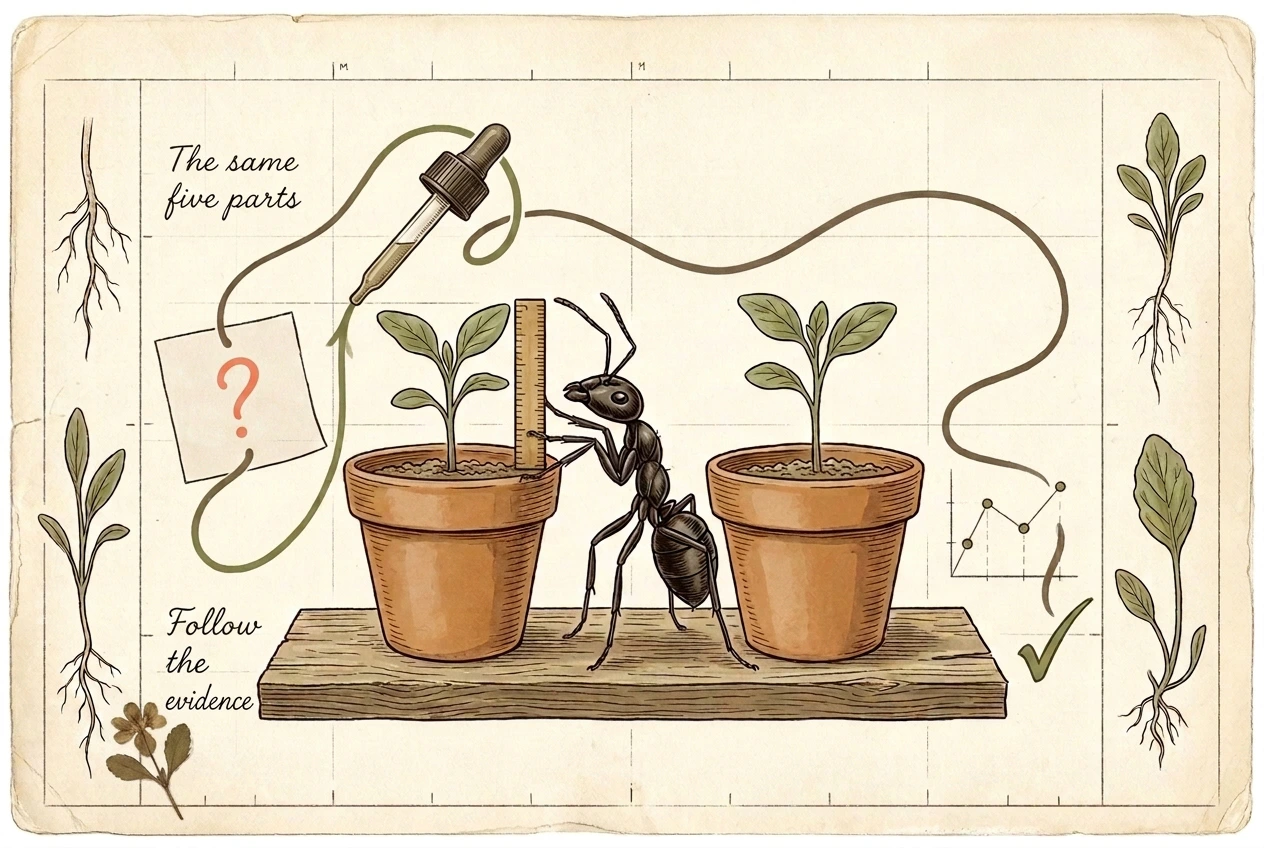
Fruit ripening. Yoghurt. Mosquito spray. An experiment question can use a very different story or set-up, but the same investigation skills return.
These are Booklet B questions built around an experiment. A question may show a set-up with variables, ask whether a comparison is fair, or give a table or graph of results. From 2026, Booklet B is worth 40 marks over 10 to 11 structured questions.
What the question is really asking
Three useful questions help you read an experiment: what am I testing?, is the comparison fair?, and what do the results show? Each part may ask you to use a different one.
The five parts
On the paper, look out for five common parts:
- The variables — name what was changed, what was measured, what was kept the same. What am I testing? → Episode 2
- The aim — both variables in one sentence. What am I testing? → Episode 3
- Fairness — change the variable being tested and keep other relevant conditions the same. A control set-up provides a comparison. Is the comparison fair? → Episode 4
- The data — describe the trend and use readings when asked for evidence. What do the results show? → Episode 5
- The fix — match the fix to the flaw, and keep the conclusion inside the data. The last two questions together. → Episode 6 and Episode 7
A question won't always ask all five. But learn to spot which one you're being asked for, and a strange new theme is just a new story around a set-up you've already practised.
Reading in order works too. Start with the variables in Episode 2. The later lessons use those variable names again.
What a strong answer does
- Use one name for a variable all the way through. The parts are a set. Call it "the amount of fertiliser" in part (a), and call it that in part (b) and part (c) too. Keep the same name, and every part matches the one before it.
- Sort the variables first, whatever the question asks first. Every other part uses them. The aim names two of them, and the fairness answer is about the ones kept the same. Thirty seconds spent naming them makes every later part quicker.
- Read the instruction and check the marks. Marks help you judge the detail needed. They are not a sentence or fact count. Cover what the part asks for, with the relevant reasoning or evidence. See the seven answering mistakes.
If you want to try this on real questions, MCQ.SG marks open-ended questions point by point and gives feedback on every answer.
For more tips on improving your answers—from avoiding common mistakes to using precise science language—explore the complete PSLE Science OEQ Guide.