Fair Tests and Control Set-Ups in PSLE Science
Part 3 of 3 of the PSLE Science OEQ Guide: build a full experiment answer, using everything from Parts 1 and 2.
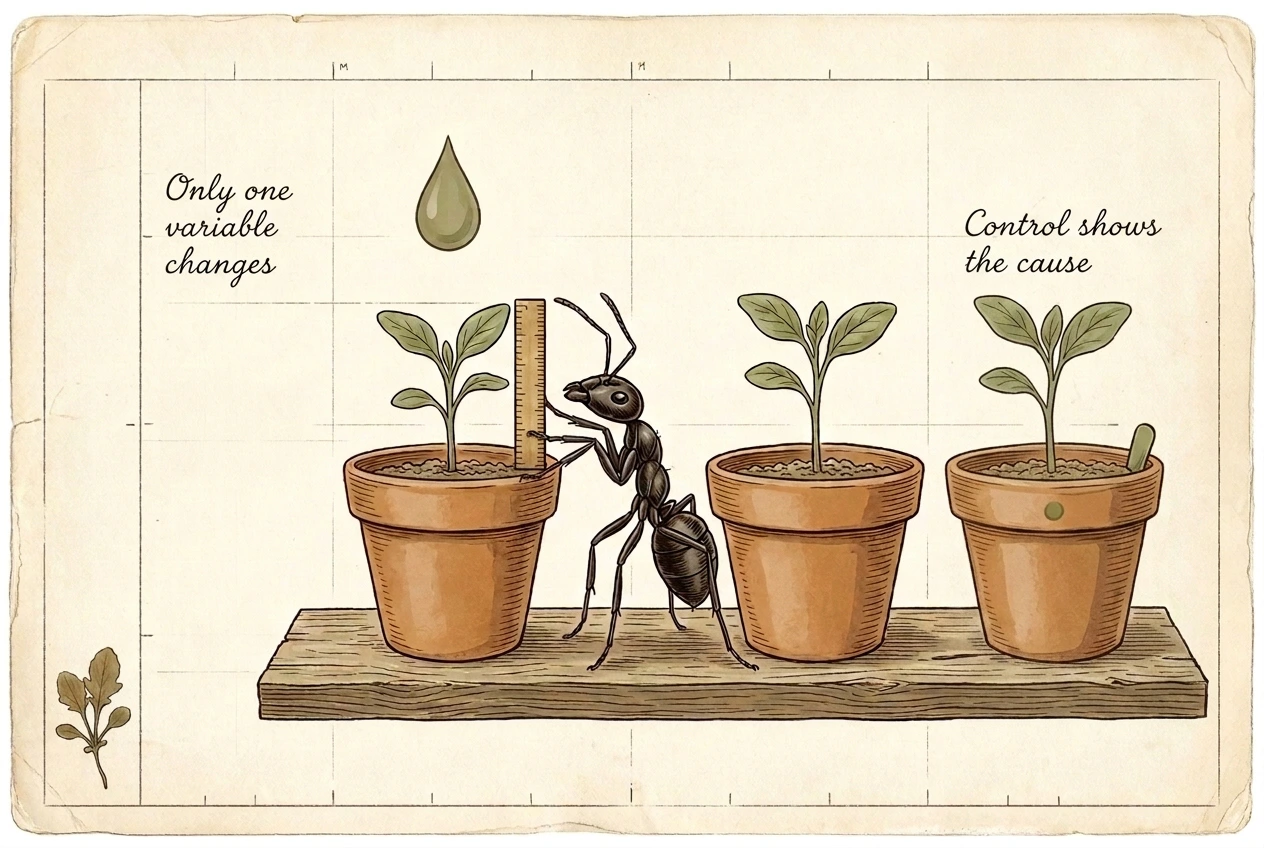
Two things get asked about here, and they're easy to mix up. So here they are, plainly.
A fair test changes the variable being tested while keeping other relevant conditions the same.
A control set-up provides a comparison, often without the treatment being tested.
Let's go through each of them one at a time.
The fair test
Change the variable being tested. Keep other conditions that could affect the result the same.
You've already seen this. It's the cookies from Episode 2 — change the butter and the flour and the eggs all at once, and a better batch tells you nothing.
This helps us investigate the effect of the changed variable. If two relevant variables change together, either could affect the result, so we cannot tell which explains the difference.
The control set-up
A comparison set-up, often without the treatment being tested.
Why would we want a set-up without the thing we're testing in it? Here's what goes wrong when there isn't one.
A student wants to know whether adding fertiliser affects plant growth. She gives a plant some fertiliser, waits three weeks, and it grows 5 cm.
Did the added fertiliser make it grow more?
You can't tell from this plant alone. It can make food by photosynthesis and use mineral salts already in the soil. Maybe it would have grown 5 cm without the added fertiliser.
So she grows a similar plant beside the first, with the same starting height, type of pot, soil, water and sunlight, but no added fertiliser. That second plant is the control set-up.
Three weeks later, the plant without added fertiliser has grown 2 cm. The one given fertiliser has grown 5 cm.
Now she can compare growth with and without added fertiliser. The fertilised plant grew 3 cm more in this trial. Repeating with more similar plants would help check whether that difference is consistent.
Telling the two questions apart
| Fair-test question | Control set-up question | |
|---|---|---|
| How the question is asked | "Is this a fair test? Explain your answer." | "State the purpose of Set-up B." |
| What it really asks | Were other relevant variables kept the same? | What comparison does this set-up provide? |
| What the answer needs | Whether only one variable was changed. | What comparing the two set-ups shows. |
What a strong answer does
- Explains the comparison. "To ensure a fair test" alone does not explain why a condition is kept the same. Name the condition and how it could affect the measured result.
- Says what the control lets you compare. Identify the treatment being tested and the result being measured.
- Blames the extra variable. When two set-ups differ in the changed variable and in one more thing, the flaw is that one more thing — never the changed variable, which was always meant to differ.
- Follows the instruction. If asked to explain an unfair comparison, identify the extra variable and explain why it matters. Use the marks as a clue to detail, not a fixed number of points. See the seven answering mistakes.
For more tips on improving your answers—from avoiding common mistakes to using precise science language—explore the complete PSLE Science OEQ Guide.