Reliability vs Accuracy in PSLE Science
Part 3 of 3 of the PSLE Science OEQ Guide: build a full experiment answer, using everything from Parts 1 and 2.
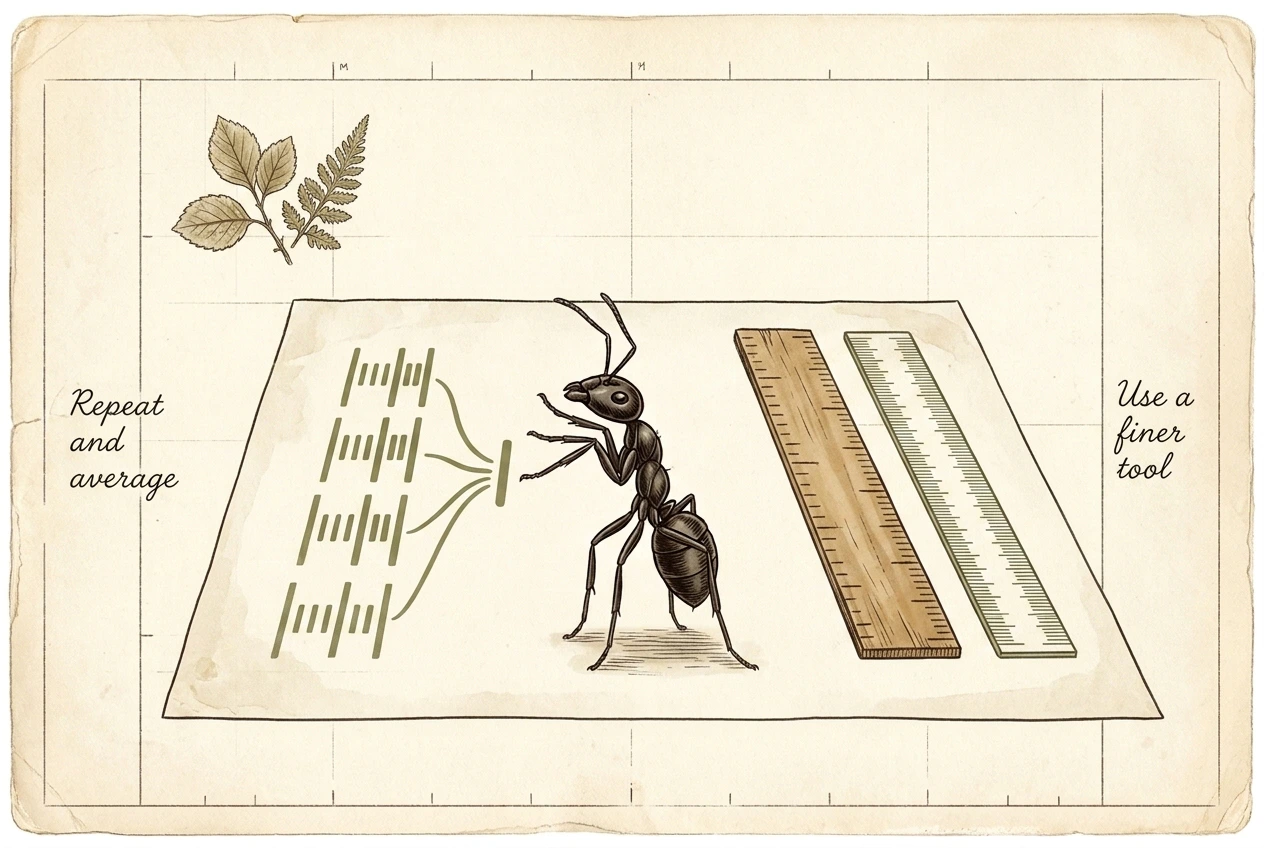
"Explain why the test was repeated three times." "Explain why a measuring cylinder was used, not a beaker." Both ask how a method helps the results. Explain the benefit instead of relying on the words "reliable" or "accurate" alone.
The idea in plain words
Reliability is about consistency when a test is repeated under the same conditions. Repeating lets you compare readings. Taking an average can reduce the effect of small random variations, such as differences in when a stopwatch is pressed. A very different reading still needs checking; averaging does not make it disappear.
Accuracy means being close to the true value. Averaging can help with random variation, but it cannot remove an error repeated in the same direction. For example, a balance that starts at 2 g instead of zero will keep adding 2 g. Check the zero before measuring.
Choose a method that addresses the actual problem:
| Problem | Useful improvement |
|---|---|
| Readings vary between trials. | Repeat under the same conditions, compare the readings and take an average where appropriate. |
| The tool's scale is too coarse for the measurement. | Use a suitable tool with finer divisions, such as a measuring cylinder instead of a beaker for volume. |
| The instrument starts from the wrong zero. | Correct the zero before measuring. Repeating alone will not fix it. |
Use the number of repeats specified in the question. If asked to suggest an improvement, you could propose three trials under the same conditions and compare the readings. Three is a practical example, not a guarantee that an unusual result has been resolved.
What a strong answer does
- Explains the benefit. Repeating helps check consistency; averaging can reduce random variation. Say which benefit matters in this experiment.
- Links the improvement to the flaw. A measuring cylinder's finer scale helps measure small volume differences. It still needs to be read correctly. A better tool does not remove every source of error.
For more tips on improving your answers—from avoiding common mistakes to using precise science language—explore the complete PSLE Science OEQ Guide.