Why We're Building MCQ.SG
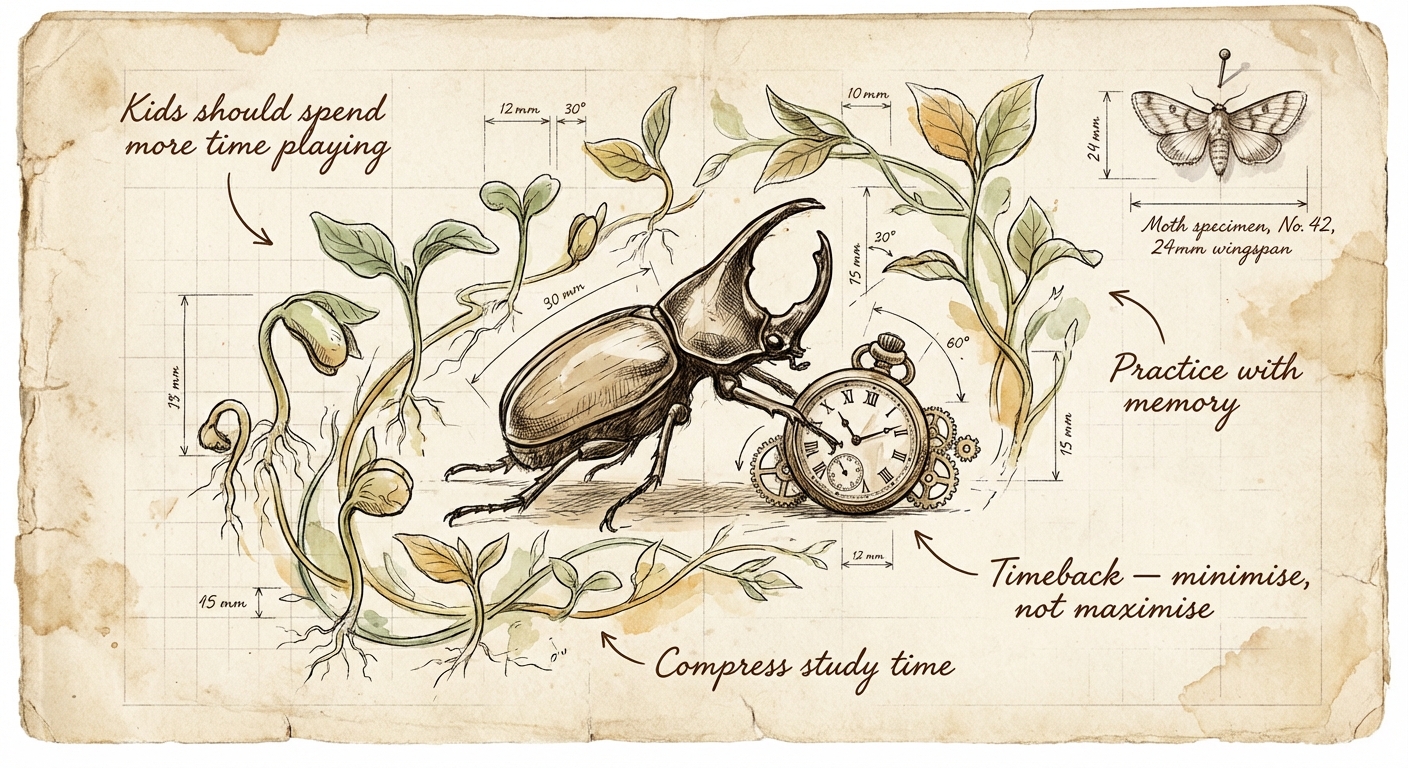
Kids should spend more time playing. More time with friends. More time outdoors, more time making things, more time being bored and figuring out what to do about it. More time discovering what they're into, what they're good at, who they want to be.
Most parents believe this. And yet somehow, the years between Primary 3 and Secondary 4 get swallowed up by tuition, revision, and practice papers.
We're not against studying. The foundations matter — numeracy, careful reading, logical reasoning. These skills unlock everything harder that comes later. We want our kids to have them.
But we don't think acquiring them should take this much time.
Traditional schooling is time-based. Every child gets the same amount of time to learn a concept, then we test and move on. But kids don't learn at the same pace. Some need two hours, some need ten. When everyone gets five, some are bored and some are lost.
The research backs this up. Benjamin Bloom found that students tutored one-to-one with mastery-based learning outperformed 98% of their classroom peers. His insight wasn't that some kids are smarter — it's that they need different amounts of time. The problem is that personalised pacing is expensive. A classroom of 30 can't offer 30 different timelines.
But software can.
What if practice had memory?
Imagine if every question your child attempted was stored. Not just the mark, but what they answered, which concepts it tested, whether they'd seen something similar before.
After a week, you'd have a snapshot. After a month, you'd start seeing patterns — the topics that are solid, the ones that need another pass. After a year, you'd have a real picture of how your child learns.
With that picture, a few things become possible.
You can recommend the right next question — not just any question, but the one that addresses an actual gap. You can spot recurring mistakes and flag them before they become habits. And eventually, you can do something that no stack of assessment books can do: tell your child they're ready. They've covered what they need to cover. Time to stop.
That's when study time shrinks. Not because you're doing less, but because you're not wasting effort on things already mastered.
Building the foundations first
When we started building MCQ.SG, the default approach would have been to take a quiz app and add AI chat on top. That's what everyone was doing.
We didn't go that way.
Not because chat is bad. But because we wanted to think about what the foundations of a learning system should actually be. What are the core pieces you need before anything else makes sense?
We looked at AI tools that worked well. The useful ones aren't just clever — they understand context. They know what you're working on, what you've already tried. The AI is grounded in structure.
For learning, we figured the structure was: a question bank (the material), student history (the memory), and a quiz interface (the interaction). These aren't features. They're foundations. Everything else — recommendations, AI explanations, the "you're ready" signal — builds on them.
So that's what we started with. We built tools to extract MCQs from PDF exam papers. We built a history layer that tracks every attempt. We built a simple, focused quiz interface. Now we're layering on the smarter stuff, one piece at a time.
Timeback
Alpha School has this phrase we like: timeback. The idea that the goal isn't to maximise learning hours — it's to minimise them.
The education industry is in the business of selling time. More tuition hours, more practice, more screen time with learning apps. The unspoken promise is that more time equals better results.
We're trying to do the opposite. Take studying and compress it. Cut the wasted repetition, the guessing at what needs work, the anxiety of never knowing if you've done enough. Give that time back.
Back to playing. Back to friends. Back to figuring out who they are.
That's why we're building this.