PSLE Science Notes — Key Concepts by Topic
Studying for PSLE Science does not mean re-reading the entire textbook. The most effective revision strategy is to work from concise, well-organised notes that focus on the concepts examiners actually test.
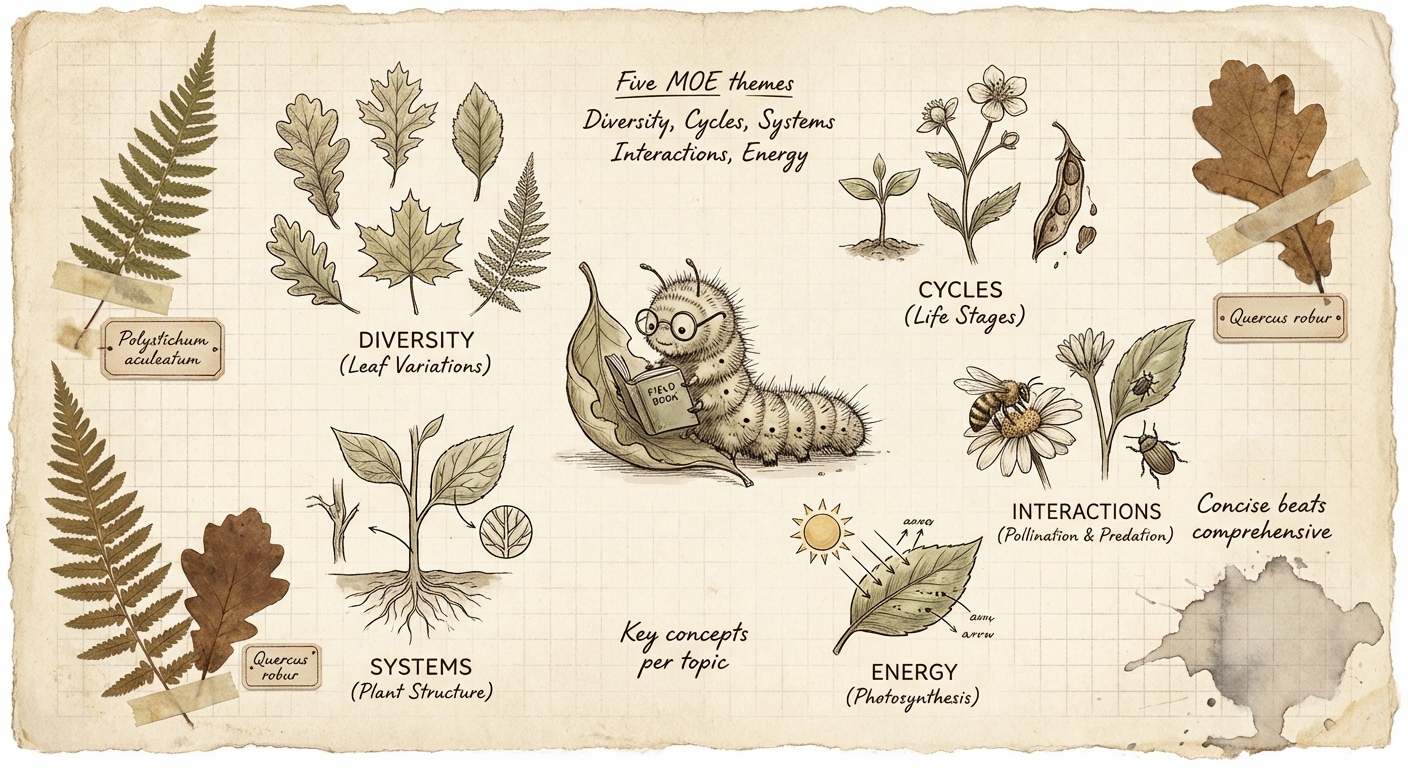
These notes cover every topic in the MOE Primary Science syllabus, grouped by the five official themes: Diversity, Cycles, Systems, Interactions, and Energy. Each theme includes the key concepts you need to know, the types of questions that appear in the PSLE, and links to topic-specific MCQ practice.
How to Use These Notes
- Read a theme section and make sure you understand each concept, not just memorise it.
- Test yourself with the MCQ practice linked at the end of each theme. If you cannot explain why the wrong answers are wrong, go back to the notes.
- Review your mistakes — the concepts you get wrong are the ones worth spending time on.
- Focus on keywords — PSLE Science markers award marks for specific scientific terms. The definitions section below lists the exact phrasing you should use.
These notes work best alongside regular MCQ practice. Reading notes alone is not enough — you need to apply what you have learnt under exam-like conditions.
Notes by Theme
The MOE Primary Science syllabus is built around five themes that spiral from Primary 3 to Primary 6, with each level adding depth to earlier concepts.
1. Diversity (Primary 3)
What it covers: Classifying living and non-living things, understanding the characteristics of different groups of organisms, and exploring the properties of materials.
Key concepts:
- Living vs non-living things — Living things need air, water, and food; they grow, reproduce, and respond to changes in the environment. Non-living things do not carry out these life processes.
- Classifying animals — Animals are grouped by observable characteristics: mammals (body hair, give birth to live young), birds (feathers, lay eggs), reptiles (dry scales, lay eggs), amphibians (moist skin, live on land and in water), fish (wet scales, gills), insects (six legs, three body parts).
- Classifying plants — Flowering plants produce flowers, fruits, and seeds. Non-flowering plants (ferns, mosses) reproduce using spores.
- Materials and their properties — Materials can be classified by properties such as flexibility, strength, transparency, and ability to absorb water. The choice of material for an object depends on its purpose.
Common exam questions: Classification tables, identifying characteristics of organism groups, matching materials to their uses based on properties.
2. Cycles (Primary 4-5)
What it covers: The states of matter and changes between them, the water cycle, and the life cycles of plants and animals.
Key concepts:
- Three states of matter — Solids have a fixed shape and volume. Liquids have a fixed volume but take the shape of their container. Gases have no fixed shape or volume and spread out to fill their container.
- Changes of state — Melting (solid to liquid), freezing (liquid to solid), boiling/evaporation (liquid to gas), condensation (gas to liquid). These changes are caused by gaining or losing heat.
- The water cycle — Water evaporates from water bodies, rises and cools to form clouds (condensation), then falls as rain (precipitation). This is a continuous cycle.
- Plant life cycles — Flowering plants go through: seed, germination, growth, flowering, pollination, fertilisation, seed dispersal. Each stage has specific conditions and processes.
- Animal life cycles — Some animals undergo metamorphosis (e.g., butterfly: egg, larva, pupa, adult). Others have life cycles without metamorphosis (e.g., chicken: egg, chick, adult).
Common exam questions: Identifying states of matter from descriptions, explaining changes of state using gain/loss of heat, labelling the water cycle, sequencing life cycle stages.
Practice Matter MCQs | Practice Water Cycle MCQs | Practice Plant Reproduction MCQs
3. Systems (Primary 4-5)
What it covers: The human digestive, respiratory, and circulatory systems; plant transport systems; and electrical circuits.
Key concepts:
- Digestive system — Food is broken down in the mouth (teeth and saliva), stomach (gastric juices), and small intestine (where digested food is absorbed into the blood). The large intestine absorbs water, and undigested food is removed as waste.
- Respiratory system — Air enters through the nose, passes through the windpipe, and reaches the lungs. In the lungs, oxygen is absorbed into the blood and carbon dioxide is removed.
- Circulatory system — The heart pumps blood through blood vessels to all parts of the body. Blood carries oxygen and digested food to body cells and removes carbon dioxide and waste products.
- Plant transport system — Water and mineral salts are absorbed by the roots and transported through the stem to the leaves.
- Electrical circuits — A complete circuit is needed for electric current to flow. Components include batteries, wires, bulbs, and switches. Series circuits have one pathway; parallel circuits have multiple pathways.
Common exam questions: Labelling organs and their functions, tracing the path of food/air/blood, identifying complete vs incomplete circuits, predicting what happens when a component is added or removed.
Practice Electrical Circuits MCQs
4. Interactions (Primary 6)
What it covers: How organisms interact with one another and their environment, food chains and food webs, forces and their effects, and adaptations.
Key concepts:
- Food chains — Energy flows from the Sun to producers (green plants) to consumers. Arrows show the direction of energy flow. Removing one organism creates a ripple effect on populations in both directions.
- Food webs — Multiple interconnected food chains in an ecosystem. A change in one population affects multiple organisms because most organisms have more than one food source.
- Adaptations — Structural adaptations (physical features) and behavioural adaptations (actions) help organisms survive in their environment. Examples: thick fur for cold environments, nocturnal behaviour to avoid predators.
- Forces — A force is a push or pull that can change the speed, direction, or shape of an object. Types include gravitational force (pulls objects towards Earth), friction (opposes motion), and elastic spring force.
- Man's impact on the environment — Deforestation, water pollution, and air pollution affect habitats and food chains. Conservation efforts aim to protect ecosystems.
Common exam questions: Constructing and interpreting food chains/webs, predicting population changes, identifying adaptations, force diagrams, environmental impact questions.
Practice Food Chains MCQs | Practice Food Webs MCQs | Practice Forces MCQs
5. Energy (Primary 4-6)
What it covers: Forms of energy, energy conversion, heat transfer, light, and photosynthesis.
Key concepts:
- Forms of energy — Light energy, heat energy, sound energy, kinetic energy (energy of movement), potential energy (stored energy — gravitational and elastic), electrical energy, and chemical energy (stored in food, fuels, batteries).
- Energy conversion — Energy can be converted from one form to another but cannot be created or destroyed. Examples: a torch converts chemical energy (battery) to electrical energy to light energy.
- Heat transfer — Heat flows from a warmer object to a cooler object. Conductors (metals) allow heat to pass through easily. Insulators (wood, plastic) slow down heat transfer.
- Light — Light travels in straight lines. It can be reflected (bounces off a surface) or refracted (bends when passing from one medium to another). Shadows form when light is blocked by an opaque object.
- Photosynthesis — Green plants use sunlight, water, and carbon dioxide to make food (glucose) and release oxygen. This process requires chlorophyll in the leaves.
Common exam questions: Identifying energy conversions in everyday appliances, explaining why certain materials are used as conductors or insulators, shadow formation, conditions needed for photosynthesis.
Practice Heat & Temperature MCQs | Practice Light MCQs
Top 10 PSLE Science Definitions
These definitions use the precise scientific keywords that PSLE markers look for. Pay attention to the key phrases.
-
Photosynthesis — The process by which green plants use sunlight, water, and carbon dioxide to make food (glucose) and release oxygen. It takes place in the chlorophyll found in the leaves.
-
Evaporation — The process by which a liquid gains heat and changes into a gas. Evaporation occurs at the surface of the liquid and can happen at any temperature.
-
Condensation — The process by which a gas loses heat and changes into a liquid. For example, water vapour in warm air loses heat when it meets a cold surface, forming water droplets.
-
Adaptation — A structural or behavioural characteristic that helps an organism survive in its environment.
-
Conductor (heat) — A material that allows heat to pass through it easily. Metals are good conductors of heat.
-
Insulator (heat) — A material that does not allow heat to pass through it easily. Wood, plastic, and rubber are good insulators.
-
Producer — An organism that makes its own food using energy from the Sun through photosynthesis. Green plants are producers.
-
Consumer — An organism that cannot make its own food and must eat other organisms to get energy.
-
Germination — The process by which a seed begins to grow into a new plant. A seed needs water, warmth, and air to germinate. It does not need sunlight or soil to begin germinating.
-
Force — A push or pull that can change the speed, direction, or shape of an object.
What Next?
Reading notes is a good start, but it is not enough on its own. PSLE Science tests application and reasoning — you need to practise using these concepts under exam conditions.
The most effective approach: read a section of notes, then immediately test yourself with MCQ questions on that topic. Check your answers, review the explanations for every question you got wrong, then move to the next topic.
For topic-by-topic MCQ practice covering everything above, head to MCQ.SG.
Frequently Asked Questions
What are the 5 themes in the PSLE Science syllabus?
The five themes are Diversity, Cycles, Systems, Interactions, and Energy. Diversity covers classifying living things and materials (P3). Cycles covers matter, the water cycle, and life cycles (P4-P5). Systems covers body systems, plant systems, and electrical circuits (P4-P5). Interactions covers food chains, food webs, forces, and adaptations (P6). Energy covers heat, light, photosynthesis, and energy conversion (P4-P6).
How should I study for PSLE Science?
The most effective method is active recall: read your notes, close them, and test yourself with practice questions. Focus on understanding why an answer is correct rather than memorising facts. Pay special attention to scientific keywords — PSLE markers award marks for precise terms like "gains heat" instead of "gets hot".
What topics are most commonly tested?
Based on past PSLE papers, the most commonly tested topics include energy conversion, photosynthesis, food chains and food webs, the water cycle, electrical circuits, and adaptations.
Are these notes enough to score well?
These notes cover all the key concepts in the MOE syllabus, but notes alone are not enough. You need to practise applying these concepts through MCQ and open-ended questions. Use these notes as your revision foundation, then build confidence through regular practice.