PSLE Preparation — A Parent's Guide to Science Success
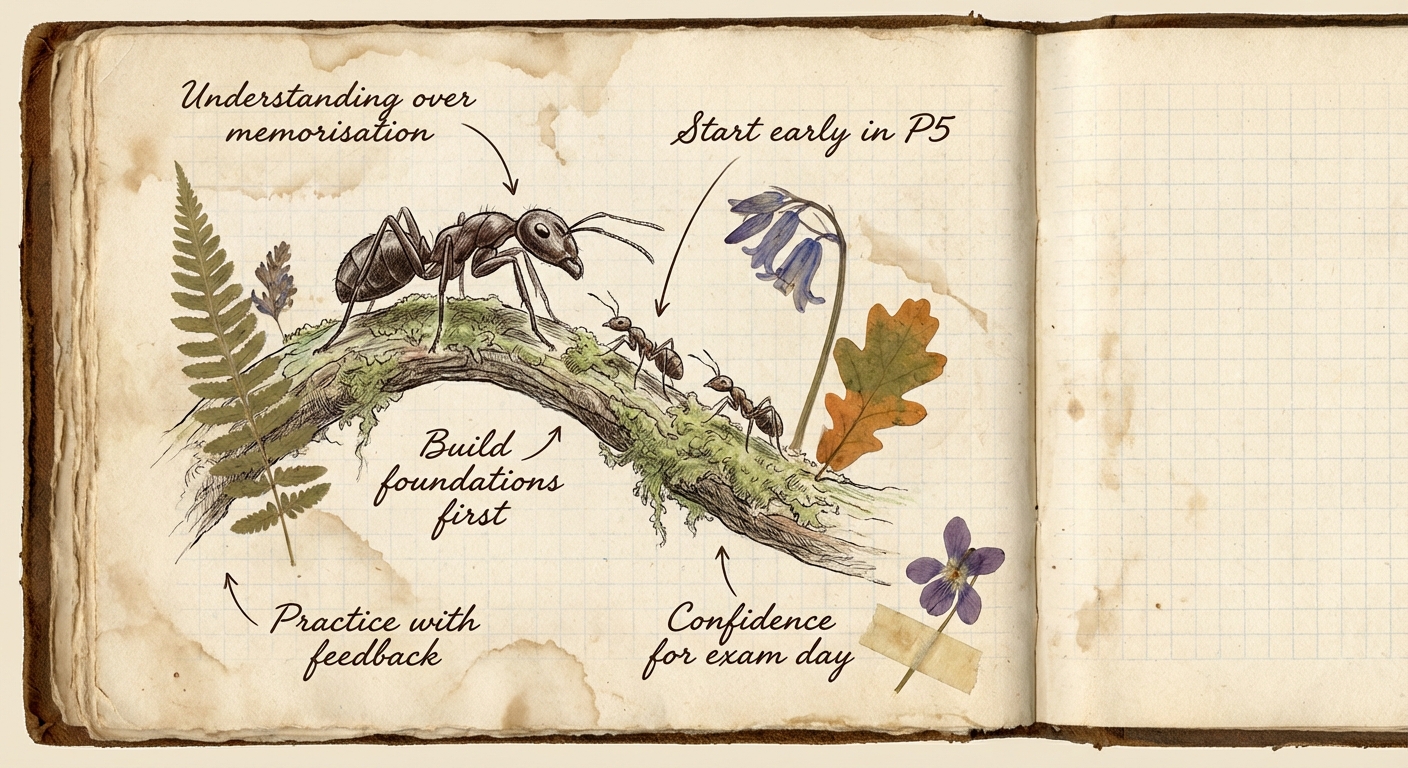
The Primary School Leaving Examination is a milestone for every Singaporean student. Among the four subjects, science often catches families off guard — it rewards understanding over memorisation, and application questions can be tricky even for students who "know the content".
This guide is written for parents who want to help their child prepare for PSLE Science with confidence. Whether your child is in Primary 5 and building foundations or in Primary 6 and heading into the final stretch, you will find a clear timeline, practical strategies backed by learning science, and free practice questions to get started today.
Understanding the PSLE Science Syllabus
PSLE Science covers topics taught from Primary 3 to Primary 6, organised around five themes:
- Diversity — classifying living and non-living things, plants, animals, fungi, bacteria
- Cycles — life cycles, matter (states and the water cycle), reproduction in plants and animals
- Systems — human body systems (digestive, respiratory, circulatory), plant systems, electrical circuits
- Interactions — forces, interactions within the environment (food chains, food webs, adaptations)
- Energy — light, heat, photosynthesis, forms and conversion of energy
Not all topics carry equal weight. Based on past PSLE papers, Interactions and Energy tend to feature heavily, particularly questions on food chains, food webs, forces, heat transfer, and energy conversion. Systems questions on the human body and electrical circuits also appear consistently.
The exam has two booklets. Booklet A contains 30 multiple-choice questions worth 60 marks in total. Booklet B contains 10 to 11 open-ended questions worth 40 marks. The total exam time is 1 hour 45 minutes.
Note for 2026: The revised syllabus places greater emphasis on skills over content recall. The topic on Cells has been removed. Questions increasingly test whether students can apply concepts to unfamiliar scenarios rather than simply recall definitions.
When to Start Preparing
A realistic timeline for PSLE Science preparation:
Primary 5 (foundation year)
Use this year to build genuine understanding of each topic as it is taught. Do not race ahead to P6 content — a student who truly understands P5 topics like electrical circuits, the water cycle, and reproduction will find P6 revision far smoother. Review each topic with a few practice questions after it is covered in school.
P6 January to June (systematic revision)
Begin a structured review of all topics from P3 to P6. Aim to cover two to three topics per week, starting with the ones your child finds most challenging. This is the time to identify and close knowledge gaps — not to do full exam papers.
A focused 60 to 90 minutes of science revision on school days, and two to three hours on weekends, is enough for most students.
P6 July to September (intensive practice)
Shift to timed past-year papers and school prelim papers. The goal here is exam technique: managing time across Booklet A and Booklet B, reading questions carefully, and structuring open-ended answers. After each paper, spend equal time reviewing every wrong answer. The review is where the real learning happens.
P6 October (final revision)
In the final weeks before the written exam, focus on your child's weakest topics and most common mistake patterns. Avoid cramming new content. Keep sessions short and confidence-building.
Effective Study Strategies
Not all study methods are equally effective. Research on how people learn points to a few strategies that consistently outperform passive re-reading.
Test yourself, don't just re-read. Retrieval practice — the act of pulling information from memory — strengthens learning far more than reading notes again. When your child finishes a topic, close the textbook and try practice questions immediately. Getting questions wrong is part of the process; it highlights exactly what needs more work.
Space it out. Studying a topic once and moving on leads to rapid forgetting. Instead, revisit each topic at increasing intervals — a few days later, then a week later, then a fortnight later. This spaced practice builds durable long-term memory.
Practice with MCQs. Booklet A is worth 60 out of 100 marks — more than half the exam. Regular MCQ practice trains your child to read questions precisely, eliminate wrong options, and avoid common traps. After each question, review the explanation for every option, not just the correct one. Try our P6 Science questions for targeted practice.
Aim for understanding, not memorising. PSLE Science increasingly tests application — students must use concepts in unfamiliar contexts. Encourage your child to explain concepts in their own words. If they can teach a topic to you clearly, they understand it. If they can only recite a definition, they are at risk on application questions.
Learn from wrong answers. Keep a mistake log — a simple notebook where your child writes down each question they got wrong, why the correct answer is right, and why their chosen answer was wrong. Reviewing this log before exams is far more efficient than re-doing entire papers.
Common Mistakes to Avoid
Starting too late. Waiting until P6 to begin revision means racing through three years of content in months. Students who build strong foundations in P5 have a significant advantage.
Memorising without understanding. Some students can recite that "the arrow in a food chain shows the direction of energy flow" but cannot apply this to a novel food chain scenario. PSLE Science rewards understanding, not recall.
Neglecting Booklet A. Many families focus heavily on open-ended Booklet B practice because the questions seem harder. But Booklet A is worth more marks (60 vs 40) and careless errors on MCQs add up quickly. Dedicate specific practice sessions to MCQ technique.
Not reviewing wrong answers. Completing ten papers without reviewing mistakes is less effective than completing three papers and thoroughly analysing every error.
Studying only favourite topics. Students naturally gravitate towards topics they enjoy. Build a revision plan that allocates more time to weaker topics, not less. Check your child's school assessment results to identify which themes need the most attention.
What About Tuition and Online Platforms?
Many parents wonder whether they need tuition or an online learning platform for PSLE Science. The honest answer: it depends on your child.
If your child understands concepts but needs more practice, free resources like MCQ.SG and past year school papers may be sufficient. The key is consistent practice with review of mistakes.
If your child struggles to grasp concepts in the first place, video-based platforms like Superstar Teacher or comprehensive platforms like Geniebook can help fill gaps. For maths specifically, KooBits is worth considering.
The most important factor is not which platform you use — it is whether your child engages with it regularly and reviews their mistakes.
Frequently Asked Questions
When should I start preparing my child for PSLE Science?
Ideally, preparation begins in Primary 5 by ensuring your child builds a strong understanding of each topic as it is taught. Formal PSLE revision — systematically reviewing P3 to P6 topics — should start in January of the P6 year. Students who wait until the June holidays to begin revision often find themselves rushing through content.
How many hours should a P6 student study for PSLE Science?
A focused 60 to 90 minutes on school days and two to three hours on weekends is enough for most students. Quality matters far more than quantity — 45 minutes of active practice is more effective than two hours of passively re-reading notes. Ensure your child gets eight to nine hours of sleep, which is essential for memory consolidation.
What are the 5 themes in PSLE Science?
The five themes are Diversity (classifying living and non-living things), Cycles (life cycles, water cycle, states of matter), Systems (human body systems, electrical circuits), Interactions (forces, food chains, environment), and Energy (light, heat, photosynthesis, energy conversion). All PSLE Science questions are drawn from these themes.
How can I help my child improve their PSLE Science score?
Focus on three things: ensure your child understands concepts rather than memorises definitions, use regular practice with thorough review of wrong answers, and follow a structured revision plan that covers all five themes with extra time for weaker topics. Consistency and quality of practice matter more than the total number of papers completed.