How to Answer PSLE Science Questions — MCQ & Open-Ended Tips
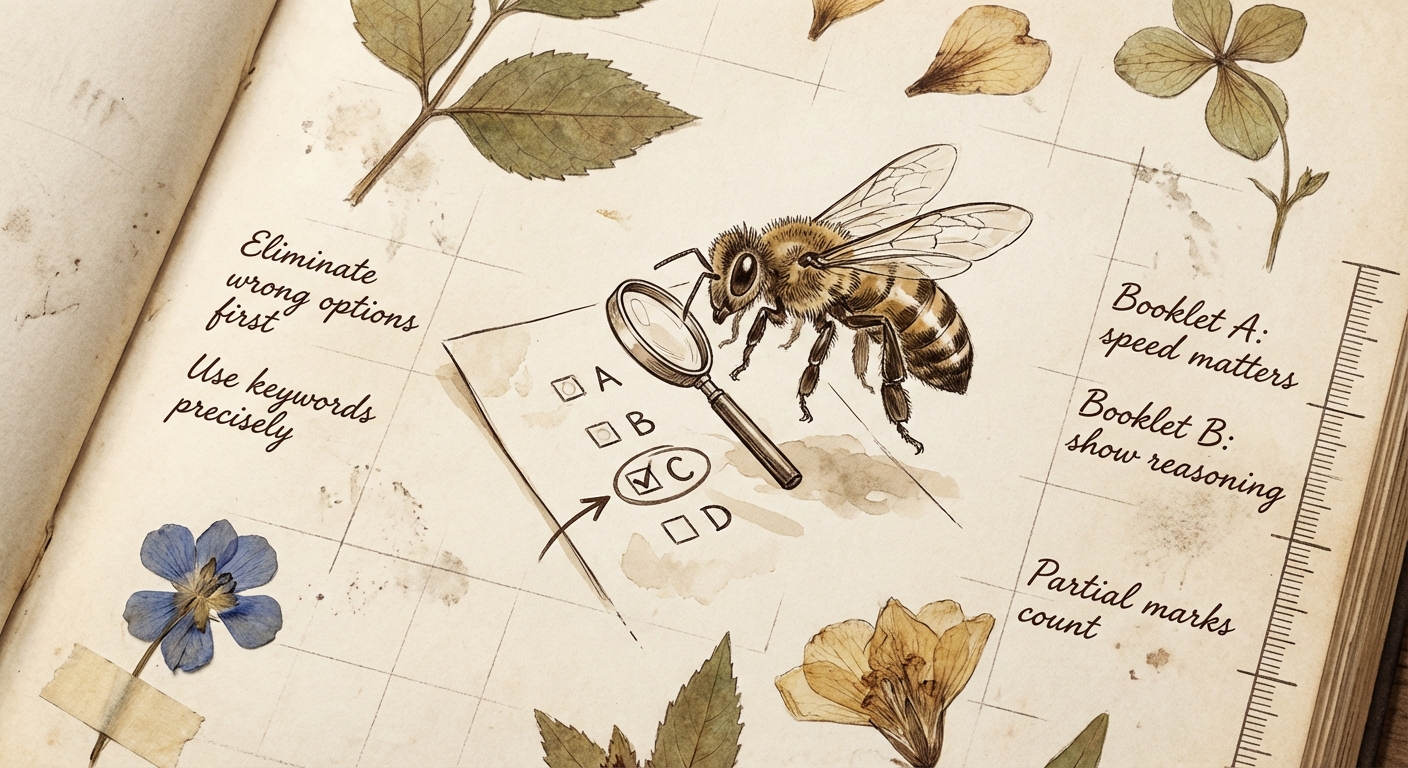
Knowing the science is only half the battle. Every year, students who understand the concepts still lose marks — not because they lack knowledge, but because they lack technique.
The PSLE Science paper is split into Booklet A (30 MCQs worth 60 marks) and Booklet B (structured questions worth 40 marks). Each booklet rewards a different set of answering skills. A student who rushes through Booklet A without reading all the options, or who writes a Booklet B answer without using precise science terms, leaves marks on the table.
This guide covers practical answering techniques for both booklets — strategies you can apply immediately to recover marks you might otherwise lose.
Booklet A: MCQ Techniques
Booklet A carries 60 marks — more than half the paper. With 30 questions to answer in roughly 45 minutes, each question gets about 1.5 minutes. Speed matters, but so does discipline.
Technique 1: Read all four options before choosing
Many students pick the first option that sounds correct. PSLE questions are designed to exploit this — Option A is often a plausible-sounding distractor. Train yourself to read all four options before committing. The best answer might be Option C or D, and you will not spot it if you have already mentally committed to A.
Technique 2: Eliminate, then choose
If you are unsure, start by crossing out options you know are wrong. Even eliminating one option improves your odds from 25% to 33%. Eliminating two gives you a 50-50 chance.
How to eliminate: look for options that contradict basic science principles, contain an obvious factual error, or describe something physically impossible.
Technique 3: Watch for absolute words
Options that contain absolute words — "always", "never", "all", "none", "only" — are more likely to be wrong. Science is full of exceptions, and examiners know that students over-generalise. Options with qualified language — "usually", "most", "some", "may" — are more likely to be correct.
This is not a guaranteed rule, but when you are stuck between two options, the one with softer language is the safer bet.
Technique 4: Circle the word "NOT"
Questions that ask "Which of the following does NOT..." are designed to catch students who skim. You are looking for the exception, not the rule. Physically circle or underline the word NOT on your question paper so your brain stays focused on finding the odd one out.
Technique 5: Flag and move on
If a question has you stuck for more than two minutes, mark your best guess, flag the question, and move on. Return to it after finishing the rest of Booklet A. Spending five minutes on one 2-mark question while rushing through three others is poor strategy.
Booklet B: Open-Ended Techniques
Booklet B is where most marks are lost — and where technique makes the biggest difference. Markers use a marking scheme with specific keywords and structures. If your answer does not include them, you lose marks even if you understand the concept.
Technique 1: Use science keywords, not everyday language
Markers look for precise terms. Writing "the ice became water" scores fewer marks than "the ice gained heat and changed state from a solid to a liquid." The science keywords — "gained heat", "changed state", "solid", "liquid" — are what the marking scheme requires.
Before answering, ask yourself: what is the science term for what I am describing?
Technique 2: The CER framework for explanation questions
For any question that asks you to "explain", structure your answer in three parts:
- Claim — State your answer directly. ("Plant A grew taller than Plant B.")
- Evidence — Refer to data from the question. ("Plant A received 8 hours of sunlight while Plant B received only 2 hours.")
- Reasoning — Connect the evidence to a science concept. ("With more sunlight, Plant A could carry out more photosynthesis to make more food for growth.")
This structure ensures you never miss the explanation component, which is where most marks come from.
Technique 3: Answer comparison questions with "whereas"
When a question asks you to compare, state both sides explicitly. Do not just describe one side and leave the other implied.
Weak answer: "Plant A grew taller because it had more sunlight."
Strong answer: "Plant A grew taller because it received more sunlight for photosynthesis, whereas Plant B grew shorter because it received less sunlight and could make less food for growth."
The word "whereas" forces you to address both sides, which is what the marking scheme requires.
Technique 4: Experiment questions — state all three variables
For questions about experimental design, always state:
- The changed variable (CV) — what you deliberately change
- The measured variable (MV) — what you observe or measure
- The kept-the-same variables — what stays constant to make it a fair test
Structure: "To find out if [CV] affects [MV], I would change [CV] and measure [MV] while keeping [list of constants] the same."
Common Mark-Losing Mistakes
Not reading the question fully. Students skim the question stem, miss a crucial detail (like "at night" or "when the switch is open"), and answer a different question entirely. Read the full question stem, including all information in tables, diagrams, and set-up descriptions.
Circular reasoning. Writing "the plant wilted because it was not healthy" explains nothing. The marker wants to know why it was not healthy. Always trace back to the underlying science concept.
Missing the "NOT". In MCQs, failing to notice "Which of the following does NOT..." leads students to pick a correct statement instead of the exception. This is a pure technique error, not a knowledge gap.
Incomplete comparisons. Stating only one side of a comparison — "Plant A grew more" without explaining what happened to Plant B and why — costs marks. Always address both sides.
Everyday language instead of science terms. "The water disappeared" instead of "the water evaporated and changed state from a liquid to a gas." Markers cannot award marks for vague descriptions, no matter how correct the underlying understanding.
Putting It Into Practice
Knowing the techniques is one thing — applying them under exam conditions is another. The only way to build these habits is through regular practice where you consciously apply each technique.
Try this approach:
- Do a set of science MCQ questions
- For each question, note which technique you used (elimination, reading all options, checking for absolute words)
- Review the explanations and check whether the technique helped you identify the right answer
- For questions you got wrong, identify which technique would have helped
Over time, these techniques become automatic. You stop losing marks to careless errors and start earning marks from questions you would previously have guessed on.
For PSLE-level MCQ practice with detailed explanations, head to MCQ.SG. Every question includes explanations for all four options — so you can see exactly why each wrong answer is wrong and practise your elimination technique.
Frequently Asked Questions
How many marks is PSLE Science Booklet A and Booklet B?
Booklet A (MCQ) has 30 questions worth 2 marks each, totalling 60 marks. Booklet B (structured) has 10 to 11 questions worth 2 to 5 marks each, totalling 40 marks. The full paper is worth 100 marks and lasts 1 hour 45 minutes. Since Booklet A carries more than half the marks, strong MCQ technique is essential.
What is the CER framework for PSLE Science?
CER stands for Claim, Evidence, and Reasoning. It is a structured way to answer explanation questions in Booklet B. First, state your Claim (your direct answer). Then, provide Evidence (refer to data or observations from the question). Finally, give the Reasoning (explain the science concept that connects the evidence to your claim).
What science keywords should I use in PSLE answers?
Use precise science terms instead of everyday language. Say "gained heat" instead of "became hot", "evaporated" instead of "disappeared", and "changed state from solid to liquid" instead of "melted into water". Markers follow a marking scheme that awards marks for specific keywords.
How should I manage my time during the PSLE Science paper?
Aim to spend about 45 minutes on Booklet A (roughly 1.5 minutes per MCQ) and 60 minutes on Booklet B. In Booklet A, if a question has you stuck for more than 2 minutes, mark your best guess and move on. In Booklet B, use the marks to budget time and check the detail needed. Answer every part of the instruction rather than counting one fact or sentence per mark.
What are the most common mistakes in PSLE Science?
The five most common mistakes are: not reading the question fully (especially missing the word "NOT"), using circular reasoning, writing incomplete comparisons that only describe one side, using everyday language instead of science terms, and rushing through MCQs without reading all four options. Most of these are technique errors that can be fixed with practice.
How do you answer PSLE Science open-ended questions?
Use the CER framework: state your Claim (direct answer), provide Evidence (refer to data or observations from the question), then give Reasoning (connect the evidence to a science concept). Always use precise science keywords instead of everyday language, and for comparison questions, address both sides using the word "whereas" to ensure you cover what the marking scheme requires.